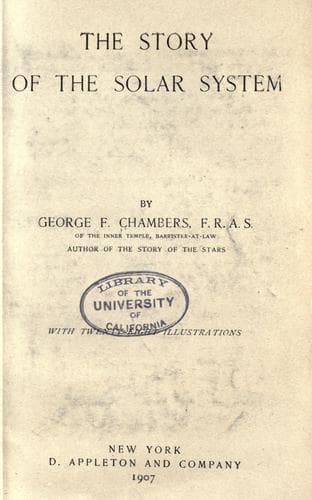
The Story of the Solar SystemChambers, George F. (George Frederick)
Science
The Story of the Solar System
Chambers, George F. (George Frederick)
Solar system
of curve usually affected by most comets, namely, the parabola. It is
true, as we shall see later on in speaking of comets, that a certain
number of those bodies do revolve in the closed curve known as the
ellipse, but it is usual to calculate the parabolic form first of all,
because it is the easier to calculate; and to persevere with it until it
plainly appears that the parabola will not fit in with the observed
movements of the new object. This practice was carried out in the case
of Herschel’s new body, and it was eventually found that not only was
its orbit not parabolic; that not only was its orbit not an elongated
ellipse of the kind affected by comets; but that it was nearly a circle,
and as the body itself showed a defined disc the conclusion was
inevitable: it was in real truth a new planet. It has not taken long to
write this statement, and it will take still less time for the reader to
read what has been written, but the result just mentioned occupied the
attention of astronomers many months in working out, step by step, in
such a way as to make sure that no mistake had been made.
When it was once clearly determined that Herschel had added a new planet
to the list of known planets it became an interesting matter of inquiry
to find out whether it had ever been seen before; and to settle the name
it should bear. A little research soon showed that the new planet had
been seen and recorded as a fixed star by various observers on 20
previous occasions, beginning as far back as Dec. 13, 1690, when
Flamstead registered at Greenwich as a star. These various observations,
spread over a period of 91 years, and all recorded by observers of skill
and eminence materially helped astronomers in their efforts to calculate
accurately the shape and nature of the new planet’s orbit. One observer,
a Frenchman named Le Monnier, saw the planet no less than 12 times
between 1750 and 1771, and if he had had (which it is known he had not)
an orderly and methodical mind, the glory of this discovery would have
been lost to England and obtained by France. Arago has left it on record
that he was once shown one of these chance observations of Uranus, which
had been recorded by Le Monnier on an old paper bag in which hair powder
had been sold by a perfumer.
Public-domain text, read in full here on John Shaqi.
Reviews
Reviews
No reviews yet
Be the first to share your thoughts on this work.
Elsewhere in the archive
Join the Discussion
Join the discussion
Sign in to leave a comment or review.
Sign InorCreate an account