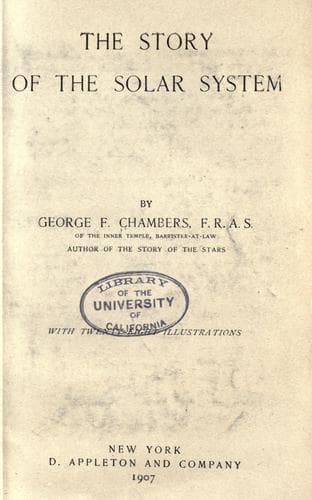
The Story of the Solar SystemChambers, George F. (George Frederick)
Science
The Story of the Solar System
Chambers, George F. (George Frederick)
Solar system
A long discussion took place on the question of a name for the new
planet. Bode’s suggestion of “Uranus” is now in universal use, but it is
within the recollection of many persons living that this planet bore
sometimes the name of the “Georgium Sidus” and sometimes the name of
“Herschel.” The former designation was proposed by Herschel himself in
compliment to his sovereign and patron George III. of England; whilst a
French astronomer suggested the latter name. However, neither of these
appellations was acceptable to the astronomers of the Continent, who
declared in favour of a mythological name, though it was a long time
before they agreed to accept Bode’s “Uranus.” The symbol commonly used
to represent the planet is formed of Herschel’s initial with a little
circle added below, though the Germans employ something else, “made in
Germany,” to quote a too familiar phrase.
The visible disc of Uranus is so small that none but telescopes of the
very largest size can make anything of it. A few sentences therefore
will dispose of this part of the subject. The disc is usually bluish in
tinge, and most observers who look at it consider it uniformly bright,
but there is satisfactory testimony to the effect that under the most
favourable circumstances of instrument and atmosphere two or more belts,
not unlike the belts of Jupiter, may be traced. From the position in
which these belts have been seen it is inferred that the satellites of
Uranus (presently to be mentioned) are unusually much inclined to the
planet’s equator, and revolve in a retrograde direction, contrary to
what is the ordinary rule of the planets and satellites. It is assumed
as the basis of these ideas, (and by analogy it is reasonable to do
this) that the belts are practically parallel to the planet’s equator,
and at right angles to the planet’s axis of rotation. To speak of the
planet’s axis of rotation is, in one sense, another assumption, because
available observations can scarcely be said to enable us to demonstrate
that the planet does rotate on its axis, yet we can have no moral doubt
about it. Taylor has suggested grounds for the opinion that “there can
be very little doubt that Uranus is to a very large extent
self-luminous, and that we do not see it wholly by reflected light.” To
this Gore adds the idea that there is “strong evidence in favour of the
existence of intrinsic heat in the planet.”
Public-domain text, read in full here on John Shaqi.
Reviews
Reviews
No reviews yet
Be the first to share your thoughts on this work.
Elsewhere in the archive
Join the Discussion
Join the discussion
Sign in to leave a comment or review.
Sign InorCreate an account