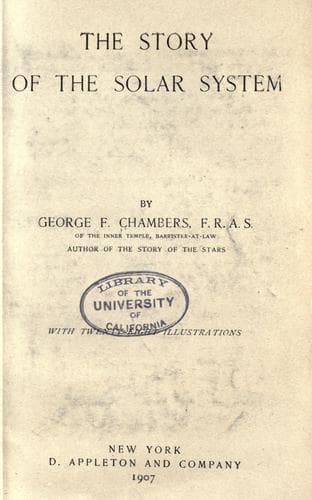
The Story of the Solar SystemChambers, George F. (George Frederick)
Science
The Story of the Solar System
Chambers, George F. (George Frederick)
Solar system
We now come to the best known planet of the solar system, reckoning
outwards from the Sun, and though this planet itself, as an object to
look at, has no particular interest for the general public, yet the
history of its discovery is a matter of extreme interest. Moreover, it
is very closely mixed up with the history of the planet Uranus, which
has just been described. After Uranus had become fully recognised as a
regular member of the solar system, a French astronomer named Alexis
Bouvard set himself the task of exhaustively considering the movements
of Uranus with a view of determining its orbit with the utmost possible
exactness. His available materials ranged themselves in two groups:—the
modern observations between 1781 and 1820, and the early observations of
Flamsteed, Bradley, Mayer, and Le Monnier, extending from 1690 to 1771.
Bouvard found in substance that he could frame an orbit which would fit
in with each group of observations, but that he could not obtain an
orbit which would reconcile both sets of observations during the 130
years over which they jointly extended. He therefore rashly came to the
conclusion that the earlier observations, having been made when methods
and instruments were alike relatively imperfect, were probably
inaccurate or otherwise untrustworthy, and had better be rejected. This
seemed for awhile to solve the difficulty, and results which he
published in 1821 represented with all reasonable accuracy the then
movements of the planet. A very few years, however, sufficed to reveal
discordances between observation and theory, so marked and regular as to
make it perfectly clear that it was not Bouvard’s work which was faulty
but that Uranus itself had gone astray through the operation of definite
but as yet unknown causes. What these causes were could only be a matter
of surmise based upon the evident fact that there was some source of
disturbance which was evidently throwing Uranus out of its proper place
and regular course. First one and then another astronomer gave attention
and thought to the matter, and eventually the conclusion was arrived at
that there existed, more remote from the Sun than Uranus, an
undiscovered planet which was able to make its influence felt by
deranging the movements of Uranus in its ordinary journey round the Sun
every 84 years. This conclusion on the part of astronomers becoming
known, a young Cambridge student, then at St. John’s College, John Couch
Adams by name, resolved, in July 1841, to take up the subject, though it
was not until 1843 that he actually did so. The problem to be solved was
to suggest the precise place in the sky at a given time of an imaginary
planet massive enough to push, or pull, out of its normal place the
planet Uranus, which was evidently being pushed at one time and pulled
at another. It would also be part of the problem to predict the distance
from the Sun of the planet thus imagined to exist. Adams worked
Public-domain text, read in full here on John Shaqi.
Reviews
Reviews
No reviews yet
Be the first to share your thoughts on this work.
Elsewhere in the archive
Join the Discussion
Join the discussion
Sign in to leave a comment or review.
Sign InorCreate an account