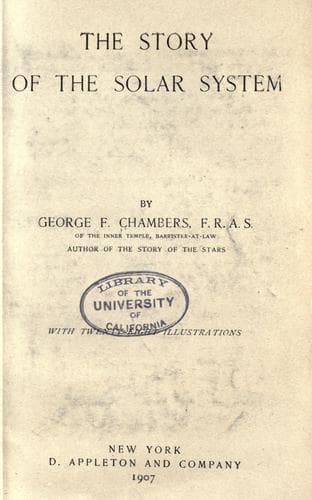
The Story of the Solar SystemChambers, George F. (George Frederick)
Science
The Story of the Solar System
Chambers, George F. (George Frederick)
Solar system
patiently and silently at this very profound and difficult problem for
1¾ years when he found himself able to forward to Airy, who had become
Astronomer Royal after being a Cambridge Professor, some provisional
elements of an imaginary planet of a size, at a distance, and in a
position to meet the circumstances. It is greatly to be regretted, on
more grounds than one, that Airy did nothing but pigeon-hole Adams’s
papers. Had he done what might have been, and probably was, expected,
that is, had he made them public, or better still had he made telescopic
use of them, a long and unpleasant international controversy would have
been avoided, and Adams would not have been robbed in part of the
well-deserved fruits of his protracted labours.
We must now turn to consider something that was happening in France. In
the summer of 1845, just before Adams had finished his work, and one and
a half years after he commenced it a young Frenchman, who afterwards
rose to great eminence, U. J. J. Le Verrier, turned his attention to the
movements of Uranus with a view of ascertaining the cause of their
recognised irregularity. In November 1845 he made public the conclusion
that those irregularities did not exclusively depend upon Jupiter or
Saturn. He followed this up in June 1846 by a second memoir to prove
that an unknown exterior planet was the cause of all the trouble, and he
assigned evidence as to its position very much as Adams had done 8
months previously. Airy on receiving a copy of Le Verrier’s memoir seems
so far, at last, to have been roused that he took the trouble to compare
Le Verrier’s conclusions with those of Adams so long in his possession
neglected. Finding that a remarkably close accord existed between the
conclusions of the two men, he came to realise that both must be of
value, and he wrote a fortnight later to suggest to Professor Challis
the desirability of his instituting a search for the suspected planet.
Challis began within two days, but was handicapped by not having in his
possession any map of the stars in the neighbourhood suggested as the
_locale_ of the planet. He lost no time however in making such a map,
but, of course, the doing so caused an appreciable delay, and it was not
until September 29, 1846, that he found an object which excited his
suspicions and eventually proved to be the planet sought for. It was
subsequently ascertained that the planet had been recorded as a star on
August 4 and 12, and that the star of August 12 was missing from the
zone observed on July 30. The discovery of the planet was therefore just
missed on August 12 because the results of each evening’s work were not
adequately compared with what had gone before.
Public-domain text, read in full here on John Shaqi.
Reviews
Reviews
No reviews yet
Be the first to share your thoughts on this work.
Elsewhere in the archive
Join the Discussion
Join the discussion
Sign in to leave a comment or review.
Sign InorCreate an account