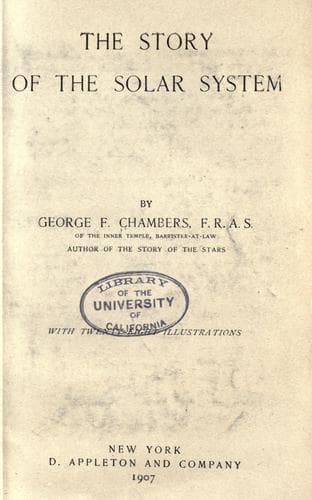
The Story of the Solar SystemChambers, George F. (George Frederick)
Science
The Story of the Solar System
Chambers, George F. (George Frederick)
Solar system
Unless there does exist a trans-Neptunian planet, a Neptunian astronomer
will know very little about planets, for Uranus and Saturn will alone be
visible to him. Both will of course be what we call “inferior planets,”
and under the best of circumstances will cut a poor figure in the
Neptunian sky.
CHAPTER XIII.
COMETS.
I suppose that it is the experience of all those who happen to be in any
sense, however humble, specialists in a certain branch of science, that
from time to time, they are beset with questions on the part of their
friends respecting those particular matters which it is known that they
have specially studied. There is no fault to be found with this thirst
for information, always supposing that it is kept within due bounds; but
my motive for alluding to it here, is to see whether any well-marked
conclusion can be drawn from it, within my own knowledge as regards
astronomical facts or events. Now in the case of the science of
astronomy (for which in this connection I, for the moment, will venture
to speak), there is certainly no one department which so unfailingly, at
all times and in all places, seems to evoke such popular sympathy and
interest as the department which deals with Comets.
Sun-spots may come and go; bright planets may shine more brightly; the
Sun or Moon may be obscured by eclipses; temporary stars may burst
forth,—all these things are within the ken of the general public by
means of newspapers or almanacs, but it is a comet which evokes more
questionings and conversations than all the other matters just referred
to put together. When a new and bright comet appears, or even when any
comet not very bright gets talked about, the old question is still fresh
and verdant—“Is there any danger to the Earth to be apprehended from
collision with a Comet?” followed by “What is a Comet?” “What is it made
of?” “Has it ever appeared before?” “Will it come back again?” and so
on. Questions in this strain have more often than I can tell of been put
to me. They seem the stock questions of all who will condescend to
replace for five minutes in the day the newest novel or the pending
parliamentary election.
It may be taken as a fact (though in no proper sense a rule) that a
bright and conspicuous comet comes about once in 10 years, and a very
remarkable comet every 30 years. Thus we have had during the present
century bright comets in 1811, 1825, 1835, 1843, 1858, 1861, 1874 and
1882, whereof those of 1811, 1843, and 1858 were specially celebrated.
Tested then by either standard of words “bright and conspicuous,” or
“specially celebrated,” it may be affirmed that a good comet is now due,
so let us prepare for it by getting up the subject in advance.
Public-domain text, read in full here on John Shaqi.
Reviews
Reviews
No reviews yet
Be the first to share your thoughts on this work.
Elsewhere in the archive
Join the Discussion
Join the discussion
Sign in to leave a comment or review.
Sign InorCreate an account