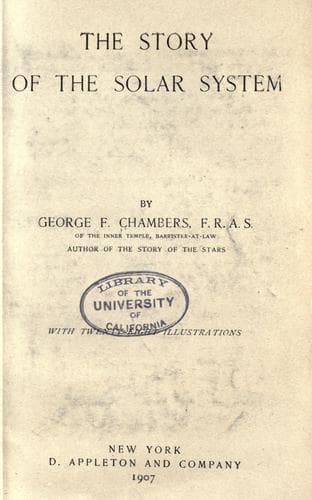
The Story of the Solar SystemChambers, George F. (George Frederick)
Science
The Story of the Solar System
Chambers, George F. (George Frederick)
Solar system
I will not attempt to answer in regular order or in any set form the
questions which I have just mentioned as being stock questions, but they
will be answered in substance as we go along. There is one matter in
connection with comets which has deeply impressed itself upon the public
mind, and that is the presence or absence of a “tail.” It is not too
much to say that the generality of people regard the tail of a comet as
_the_ comet; and that though an object may be a true comet from an
astronomer’s point of view, yet if it has no tail its claims go for
nought with the mass of mankind. We have here probably a remnant of
ancient thought, especially of that line of thought which in bygone
times associated Comets universally with the idea that they were
especially sent to be portents of national disasters of one kind or
another. This is brought out by numberless ancient authors, and by none
more forcibly than Shakespeare. Hence we have such passages as the
following in _Julius Cæsar_ (Act ii., sc. 2):—
“When beggars die there are no comets seen,
The Heavens themselves blaze forth the death of princes.”
In _Henry VI._ (Part I., Act i., sc. 1) we find the well-known passage:—
“Comets importing change of times and states
Brandish your crystal tresses in the sky,
And with them scourge the bad revolting stars
That have consented unto Henry’s death.”
There are in point of fact two distinct ideas evolved here: (1) that
comets are prophetic of evil, and (2) stars potential for evil.
There is another passage in _Henry VI_. (Part I., Act iii., sc. 3) even
more pronounced:—
“Now shine it like a Comet of revenge,
A prophet to the fall of all our foes.”
Again; in _Hamlet_ (Act i., sc. 1) we find:—
“As stars with trains of fire, and dews of blood,
Disasters in the Sun.”
Once more; in the _Taming of the Shrew_ (Act iii., sc. 2) we have the
more general, but still emphatic enough, idea expressed by the simple
words of reference to—
“Some Comet or unusual prodigy.”
Shakespeare may be said to have lived at the epoch when astrology was in
high favour, and it may be that he only gave utterance to the current
opinion prevalent among all classes in those still somewhat “Dark Ages”
(so called). This, however, can hardly be said of the author of my next
quotation—John Milton (_Paradise Lost_, bk. II.):—
“Satan stood
Unterrified, and like a Comet burned,
That fires the length of Ophiuchus huge
In th’ Arctic sky, and from its horrid hair
Shakes pestilence and war.”
Jumping over a century we find the ancient theory still in vogue, or
Thomson (_Seasons_, Summer) would never have written:—
Public-domain text, read in full here on John Shaqi.
Reviews
Reviews
No reviews yet
Be the first to share your thoughts on this work.
Elsewhere in the archive
Join the Discussion
Join the discussion
Sign in to leave a comment or review.
Sign InorCreate an account