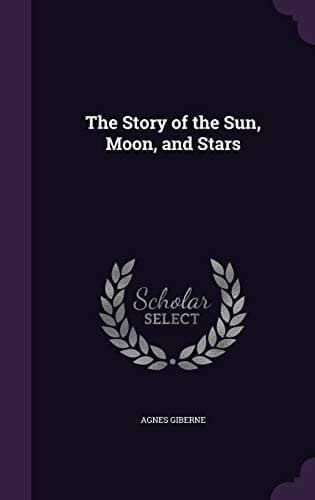
The story of the sun, moon, and starsGiberne, Agnes
Science
The story of the sun, moon, and stars
Giberne, Agnes
Astronomy -- Juvenile literature
The sun, then, acts on these bodies when they approach him, produces
in them important physical and chemical transformations, and exercises
on their developed atmosphere a repulsive force, the nature of which
is still unknown to us, but the effects of which coincide with the
formation and development of the tails. The tails are thus, in the
extension of the cometary atmosphere, driven back, either by the
solar heat, by the light, by electricity, or by other forces; and
this extension is rather a motion in the ether than a real transport
of matter, at least in the great comets which approach very near the
sun, and in their immense luminous appendages. The effects produced
and observed are not the same in all comets, which proves that they
differ from each other in several respects. The tails have sometimes
been seen to diminish before the perihelion passage, as in 1835.
Luminous envelopes have also been seen succeeding each other round the
head, concentrating themselves on the side opposite to the sun, and
leaving the central line of the tail darker than the two sides. This
is what happened in the Donati comet and in that of 1861. Sometimes a
secondary tail has been seen projected towards the sun, as in 1824,
1850, 1851, and 1880. Comets have been seen with the head enveloped in
phosphorescence, surrounding them with a sort of luminous atmosphere.
Comets have also been seen with three, four, five, and _six tails_,
like that of 1744, for example, which appeared like a splendid aurora
borealis rising majestically in the sky, until, the celestial fan being
raised to its full height, it was perceived that the six jets of light
all proceeded from the same point, which was nothing else but the
nucleus of a comet. On the other hand, the nuclei themselves show great
variations--some appear simply nebulous, and permit the faintest stars
to be visible through them; others seem to be formed of one or more
solid masses surrounded by an enormous atmosphere; in others, again, a
nucleus does not exist, as in the Southern comet of 1887. One of the
comets of 1888 showed a triple nucleus and a bristling coma, as may
be seen in the cut. We may, then, consider that the wandering bodies
collected under the name of comets are of several origins and _several
different species_.
_Why_ the tails of comets should so persistently avoid the sun it is
impossible to say. We do not even know whether the cause lies actually
in the sun or in the comet. Astronomers speak of the “repulsive
energy” with which the sun “sweeps away” from his neighborhood the
light vapory matter of which the tails are made. But the how and the
wherefore of this strange seeming repulsion they can not explain. For
at the selfsame time the sun appears to be attracting the comet towards
himself, and driving the comet’s tail away from himself.
Public-domain text, read in full here on John Shaqi.
Reviews
Reviews
No reviews yet
Be the first to share your thoughts on this work.
Elsewhere in the archive
Join the Discussion
Join the discussion
Sign in to leave a comment or review.
Sign InorCreate an account