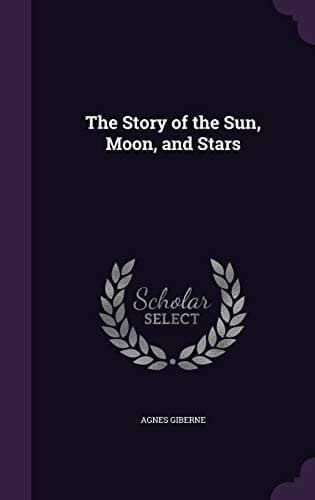
The story of the sun, moon, and starsGiberne, Agnes
Science
The story of the sun, moon, and stars
Giberne, Agnes
Astronomy -- Juvenile literature
Such distances are amazing and almost terrifying to the imagination.
The mind is bewildered and almost overwhelmed when attempting to form a
conception of such portions of immensity, and feels its own littleness,
the limited nature of its powers, and its utter incapacity for grasping
the amplitudes of creation. But though it were possible for us to wing
our flight to such a distant orb as 61 Cygni, we should still find
ourselves standing only on the verge of the starry firmament where ten
thousands of other orbs a thousand times more distant would meet our
view. We have reason to believe that a space equal to that which we are
now considering intervenes between most of the stars which diversify
our nocturnal sky. The stars appear of different magnitudes; but we
have the strongest reason to conclude that in the majority of instances
this is owing, not to the difference of their real magnitudes, but to
the different distances at which they are placed from our globe.
If, then, the distance of a star of the first or second magnitude, or
those which are nearest to us, be so immensely great, what must be the
distance of stars of the sixteenth or twentieth magnitude, which can
be distinguished only by the most powerful telescopes? Some of these
must be many millions of times more distant than the nearest star whose
distance now appears to be determined. And what shall we think of the
distance of those which lie beyond the reach of any telescope that has
yet been constructed, stretching beyond the utmost limits of mortal
vision, within the unexplored regions of immensity? Here even the most
vigorous imagination drops its wing, and owns itself utterly unable to
penetrate this mysterious and boundless unknown.
Turning now from the sun, whose distance was first measured, and from
the nearest star with which we are acquainted, let us think about the
most radiant star in the heavens--Sirius, “the blazing Dog-star of the
ancients;” named by one astronomer “the king of suns.”
First, as to the color of Sirius. He belongs to the order of “White
Suns,” and among all the white suns known to us, Sirius ranks as
chief. There may be many at greater distances far surpassing him in
size, and weight, and brilliancy; but we can only speak so far as we
know. Strange to say, Sirius was not always a “white sun;” for ancient
writers describe him as being, in their days, a _red_ star. This change
is very singular, and difficult to understand. But Sirius is not the
only example of the kind. Many alterations in color have been noticed
as taking place, often in a much shorter space of time. For instance,
one star, which was a white sun in the days of Herschel, is now a
golden sun.
Public-domain text, read in full here on John Shaqi.
Reviews
Reviews
No reviews yet
Be the first to share your thoughts on this work.
Elsewhere in the archive
Join the Discussion
Join the discussion
Sign in to leave a comment or review.
Sign InorCreate an account