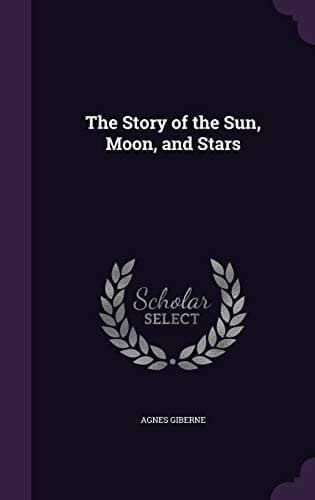
The story of the sun, moon, and starsGiberne, Agnes
Science
The story of the sun, moon, and stars
Giberne, Agnes
Astronomy -- Juvenile literature
The new theory of Copernicus had to make its way slowly against
the dead weight of unreasoning public opinion, and against
wrongly-reasoning hierarchical opposition. In time, gradually, despite
all resistance, the truth made its way, and was generally received,
though not till Galileo had been forced by ecclesiastical authority to
recant his opinions. All the same, Copernicus, Kepler, Galileo, were
right; public sentiment and the Church were wrong,--the earth did move,
and was not the fixed universe center, and, by and by, those who lived
on earth had to acknowledge the same.
The succession of these great men is interesting to note. Between the
two shining lights, Hipparchus and Ptolemy, nearly three hundred years
intervened. But as the history of the world advances, we find brilliant
scientific minds appearing more quickly, one following close upon
another, instead of their being divided by long intervals of blankness.
Within thirty years from the death of Copernicus, were born two mighty
men of Science: Kepler, who lived till 1630; and Galileo, who lived
till 1642, when England was plunged in civil strife.
Between Copernicus and Kepler came Tycho Brahe. Copernicus was a
Roman ecclesiastic, born in Poland. Tycho Brahe was a wealthy Danish
nobleman, an ardent lover of astronomy, and a most patient and accurate
observer. But Tycho held fast by the old astronomy. He was not
convinced by the arguments of Copernicus. To him, earth was still the
motionless center of all things. He was willing to allow that the rest
of the planets circled round the sun, as an explanation of things which
he could not help seeing; but the sun itself had still, in Tycho’s
imagination, to revolve daily, with planets and stars and the whole
sky, round our earth.
As an explainer of causes, therefore, Tycho rose to no lofty heights.
The real good which he did was in watching and noting actual phenomena,
not in trying to explain how those phenomena were brought about. This
was left for one of his young pupils, a sickly German lad, named John
Kepler.
In later years, Kepler made a grand use of his master’s mass of careful
and thoroughly dependable observations. These had really been gathered
together by Tycho, with a view of disproving the Copernican theory, and
of establishing the main features of the olden astronomy, with certain
improvements. But Kepler used the accumulated information to disprove
the old astronomy, and to establish the truth of the new Copernican
system which Tycho had rejected. He found a vast advantage, ready to
his hand, in the collection of careful observations systematically
worked out by Tycho in his observatory during many a long year. And
Kepler did not fail to use his advantage.
Public-domain text, read in full here on John Shaqi.
Reviews
Reviews
No reviews yet
Be the first to share your thoughts on this work.
Elsewhere in the archive
Join the Discussion
Join the discussion
Sign in to leave a comment or review.
Sign InorCreate an account