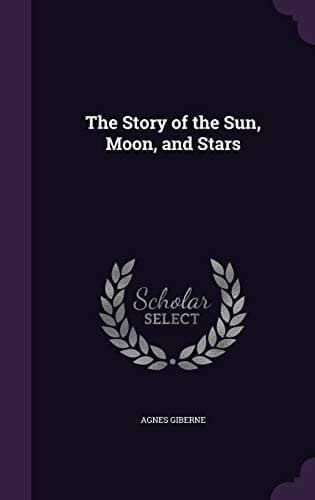
The story of the sun, moon, and starsGiberne, Agnes
Science
The story of the sun, moon, and stars
Giberne, Agnes
Astronomy -- Juvenile literature
The planets still refused, as they always had refused, to keep to the
paths marked out for them by astronomers. Kepler grappled with the
difficulty. He particularly turned his attention to Mars, that near
neighbor of ours, in which we are all now so much interested. A long
series of close observations of Mars’s movements, made by Tycho in the
course of many years, lay before him; and he knew that he could depend
upon the absolute honesty and accuracy of Tycho’s work.
With immense labor and immense patience, he went into the matter, still
clinging to the old idea of a circular pathway round the sun. He tried
things this way and that way. He placed his orbit in imagination after
one mode and another mode; he conjectured various arrangements; he
tested and proved them in turn, comparing each plan with observations
made,--and still Mars defied all his efforts; still the little world
went persistently wrong, traveling contrary to every theory.
Thus far, nobody had ever thought of an orbit of any other shape than
a circle. When a straightforward journey round a circle was found
impossible, then epicycles were introduced to explain the planet’s
perplexing motions. No one had dreamt of an elliptic pathway. But
suddenly a gleam of daylight came upon this groping in the dark. What
if Mars traveled round the sun--_not_ in a circle, but in an oval?
Kepler tried this oval and that oval, comparing observations
past--testing, examining, proving or disproving, with unwearied
patience. And at length he found, beyond dispute, that Mars actually
did travel round the sun in a yearly pathway, which was shaped, not as
a circle, but as the kind of oval known as an _ellipse_; and, further,
that the sun was not in the exact center of this ellipse, but to one
side of the center, in one of the foci. Kepler’s success in detecting
the true shape of a planetary orbit is doubtless owing to the fact
that the orbit of Mars makes a wider departure from the circular form
than any of the other important planets.
One step further would have led Kepler to the knowledge that comets
also travel in elliptic orbits--only in very long and narrow ones
generally. But he had quite made up his mind that all comets merely
paid our sun one visit, and never by any chance returned; so he did not
trouble himself to enter into calculations with respect to them. This
taking for granted of ideas long held was a very common practice in
those days.
Public-domain text, read in full here on John Shaqi.
Reviews
Reviews
No reviews yet
Be the first to share your thoughts on this work.
Elsewhere in the archive
Join the Discussion
Join the discussion
Sign in to leave a comment or review.
Sign InorCreate an account