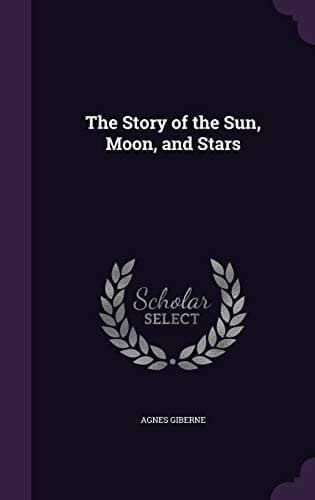
The story of the sun, moon, and starsGiberne, Agnes
Science
The story of the sun, moon, and stars
Giberne, Agnes
Astronomy -- Juvenile literature
Certain glimmerings of the notion had, indeed, begun to dawn on the
horizon of learning. Horrocks, Borelli, Robert Hook, Wren, Halley, and
others had _glimpses_ of universal gravitation; but only glimpses. A
gifted English philosopher, late in the sixteenth century, Gilbert
by name, went so far as to speak of earth and moon acting one upon
the other “like two magnets.” He also saw the effect of the moon’s
attraction in bringing about ocean tides, though he oddly explained
that the said attraction was not so much exerted upon ocean waters as
upon “subterranean spirits and humors”--whatever he may have meant by
such an expression.
Kepler, not long after Gilbert, made further advance. He gained some
definite notions as to the nature of gravity; and he saw distinctly
that the moon’s attraction was the main cause of the tides. The
following remarkable statement is found in his writings: “If the earth
ceased to attract its waters, the whole sea would mount up and unite
itself with the moon. The sphere of the attracting force of the moon
extends even to the earth, and draws the waters towards the torrid
zone, so that they rise to the point which has the moon in the zenith.”
Here is a distinct enough grasp of the fact that gravity can and does
act through distance, between worlds separated by thousands of miles.
Yet, though both Gilbert and Kepler saw so much, they failed to go
farther. Neither of the two had any clear knowledge of the modes in
which gravitation acts, or of the laws which govern its working.
Gilbert and Kepler alike, while dimly recognizing, not only the moon’s
attraction for earth’s oceans, but the mutual attraction of earth and
moon each for the other, were utterly perplexed as to what force could
possibly hold the two bodies asunder. Gilbert could seriously talk of
“subterranean spirits and humors.” Kepler could soberly write of an
“animal force” or some tantamount power in the moon, which prevented
her nearer approach to earth.
Galileo was equally vague on the subject. With all his brilliant gifts,
and while acknowledging the earth’s attractive power over the moon, he
would not even admit the existence of _mutual_ attraction, and talked
of the moon as being compelled to “follow the earth.” Unquestionably
there are times when the moon does follow the earth, and that is when
the earth happens to go before. But quite as often it happens that the
moon goes before, and the earth follows after.
Public-domain text, read in full here on John Shaqi.
Reviews
Reviews
No reviews yet
Be the first to share your thoughts on this work.
Elsewhere in the archive
Join the Discussion
Join the discussion
Sign in to leave a comment or review.
Sign InorCreate an account