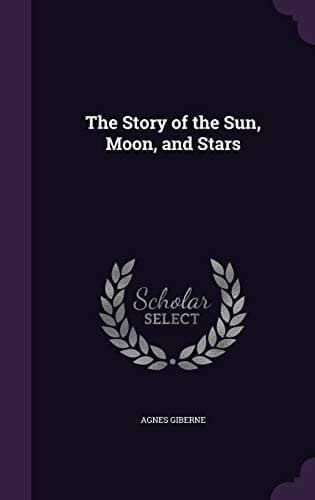
The story of the sun, moon, and starsGiberne, Agnes
Science
The story of the sun, moon, and stars
Giberne, Agnes
Astronomy -- Juvenile literature
All these great men were groping near the truth, yet none managed to
find the clue that was wanted. They left the unfinished process of
thought to be carried on by the master-mind of Newton. And Newton set
himself to think the question out. He used Kepler’s observations.
He sought to penetrate the secrets of a Solar System in mysterious
and inviolable order. Some reason or cause for that order he knew
must exist--if only it might be grasped! He pondered deeply; lost in
profound cogitation, through stormy days of civil strife, of plague and
loss and suffering. The object of his life was to discover, if so he
might, what power or what forces retained the different worlds in their
respective pathways; in short, what manner of celestial guidance was
vouchsafed to the planets.
For although men had now learned the shape of the planet-orbits, and
even knew certain laws which helped to govern the planet-motions, they
had not discovered one supreme controlling law. They did not dream of
gravity in the heavens as a prevailing force. There was absolutely no
reason, with which men were acquainted, why each planet should preserve
its own particular distance from the sun; why Mars should not wander
as far away as Jupiter; why Mercury should not flee to the position of
Saturn; why our own earth should be always about as near as she always
is.
The resources of Newton’s genius seemed equal to almost any demand
that could be made upon it. He saw that each planet must disturb the
other, and in that way he was able to render a satisfactory account of
certain phenomena which had perplexed all preceding investigators. That
mysterious movement by which the pole of the earth sways about among
the stars, had been long an unsolved enigma; but Newton showed that the
moon grasped with its attraction the protuberant mass at the equatorial
regions of the earth, and thus tilted the earth’s axis in a way that
accounted for the phenomenon which had been known, but had never been
explained, for two thousand years. All these discoveries were brought
together in that immortal work, Newton’s “Principia,” the greatest work
on science that the world had yet seen.
It may well be that, as Newton pondered this perplexing question
while seated in the garden, an apple dropping to the ground might
have sufficed to turn his wide-awake and ready mind in the direction
of that familiar force, gravity, which draws all loose bodies towards
earth’s surface. The apple fell because of gravity. Quite naturally the
question might have arisen in Newton’s mind--“Why not this same gravity
in the heavens also? If the earth draws an apple towards herself, why
should not the earth draw the moon? Why should not the sun draw the
earth? Nay, more, why should not the sun draw all the planets?” Newton
set himself to work out this problem, allowing for the distance of the
moon from earth, and for the bulk and weight of both earth and moon.
Public-domain text, read in full here on John Shaqi.
Reviews
Reviews
No reviews yet
Be the first to share your thoughts on this work.
Elsewhere in the archive
Join the Discussion
Join the discussion
Sign in to leave a comment or review.
Sign InorCreate an account