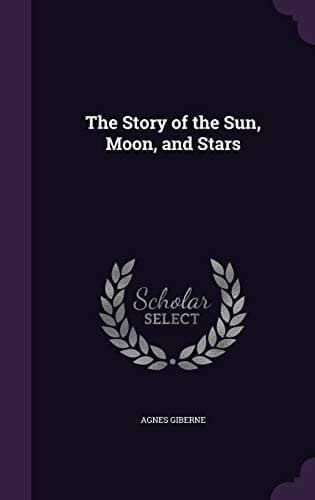
The story of the sun, moon, and starsGiberne, Agnes
Science
The story of the sun, moon, and stars
Giberne, Agnes
Astronomy -- Juvenile literature
Though no additional honors could add to his fame, Dr. Herschel, in
1816, received the decoration of the Guelphic Order of Knighthood.
In 1820 he was elected president of the Astronomical Society, and
among their Transactions, the next year, he published an interesting
memoir on the places of one hundred and forty-five double-stars. This
paper was the last which he lived to publish. His health had begun to
decline, and on the 24th of August, 1822, he sank under the infirmities
of age, having completed his eighty-fourth year. He was survived by his
widow, Lady Herschel, an only son, Sir John F. W. Herschel, and his
sister Caroline, who died in 1847, in her ninety-eighth year.
LAPLACE.
The author of “Celestial Mechanics” was born at Beaumont-en-Auge in
1749, just thirteen years later than his renowned friend Lagrange.
His father was a farmer, but appears to have been in a position to
provide a good education for a son who seemed promising. The subject
which first claimed his attention was theology. He was, however, soon
introduced to the study of mathematics, in which he presently became so
proficient that, while he was still no more than eighteen years old, he
obtained employment as a mathematical teacher in his native town.
Desiring wider opportunities for study, young Laplace started for
Paris, being provided with letters of introduction to D’Alembert,
who then occupied the most prominent positions as a mathematician in
France, if not in Europe. On presenting these letters, he seems to have
had no reply; whereupon, Laplace wrote to D’Alembert, submitting a
discussion of some point in dynamics.
This letter instantly produced the desired effect. D’Alembert thought
that such mathematical talent as the young man displayed was in itself
the best of introductions to his favor. It could not be overlooked, and
accordingly he invited Laplace to come and see him. Laplace, of course,
presented himself, and erelong D’Alembert obtained for the rising
philosopher a professorship of Mathematics in the military school in
Paris. This gave the brilliant young mathematician the opening for
which he sought, and he quickly availed himself of it.
Laplace’s most famous work is “Celestial Mechanics,” in which he
essayed a comprehensive attempt to carry out, in much greater detail,
the principles which Newton had laid down. The fact was that Newton
had not only to construct the theory of gravitation, but he had to
invent the mathematical processes by which his theory could be applied
to the explanation of the movements of the heavenly bodies. In the
course of the century which had elapsed between the time of Newton and
the time of Laplace, mathematics had been extensively developed. The
disturbances which one planet exercises upon the rest can only be fully
ascertained by the aid of long calculations, and for these calculations
analytical methods are required.
Public-domain text, read in full here on John Shaqi.
Reviews
Reviews
No reviews yet
Be the first to share your thoughts on this work.
Elsewhere in the archive
Join the Discussion
Join the discussion
Sign in to leave a comment or review.
Sign InorCreate an account