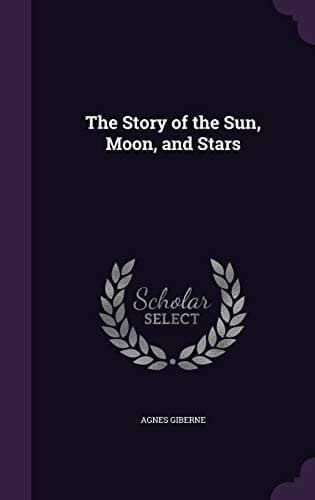
The story of the sun, moon, and starsGiberne, Agnes
Science
The story of the sun, moon, and stars
Giberne, Agnes
Astronomy -- Juvenile literature
It was not until 1782 that the great achievement took place by which
Herschel at once sprang into fame. He appears to have formed a project
for making a close examination of all the stars above a certain
magnitude for the purpose of discovering, if possible, a parallax among
them. Star after star was brought to the center of the field of view of
his telescope, and after being carefully examined, was then displaced,
while another star was brought forward to be submitted to the same
process.
In the great review which Herschel undertook, he doubtless examined
hundreds, or perhaps thousands of stars, allowing them to pass away
without note or comment. But on an ever-memorable night in March,
1782, it happened that he was pursuing his task among the stars in the
constellation of Gemini. One star was noticed which, to Herschel’s
acute vision, seemed different from the stars which in so many
thousands are strewn over the sky. There was something in the starlike
object that immediately arrested his attention, and made him apply to
it a higher magnifying power. This at once disclosed the fact that the
object possessed a disk--that is, a definite, measurable size--and
that it was thus totally different from any of the hundreds and
thousands of stars which exist elsewhere in space. The organist at the
Octagon Chapel at Bath had discovered a new planet with his home-made
telescope. Great was the astonishment of the scientific world when the
Bath organist announced that the five planets, which had been known
from all antiquity, must now admit the company of a sixth.
The now great astronomer was invited to Windsor, and to bring his
famous telescope in order to exhibit the planet to George III, and
to tell his majesty all about it. The king took so great a fancy to
Herschel that he proposed to confer on him the title of “his majesty’s
own astronomer,” to assign him a residence near Windsor, to provide him
with a salary, and to furnish such funds as might be required for the
erection of great telescopes, and for the conduct of that mighty scheme
of celestial observation on which Herschel was so eager to enter.
No single discovery of Herschel’s later years was, however, of the same
momentous description as that which first brought him to fame. There
is no separate collection of his writings, and very scanty accounts of
his life have been published; but he who has written his name among the
stars needs no other testimonial to his fame. Prior to his time the
number of bodies known as belonging to the Solar System was eighteen,
including secondary planets and Halley’s comet. To these he added nine;
namely, Uranus and six satellites, and two satellites of Saturn.
Public-domain text, read in full here on John Shaqi.
Reviews
Reviews
No reviews yet
Be the first to share your thoughts on this work.
Elsewhere in the archive
Join the Discussion
Join the discussion
Sign in to leave a comment or review.
Sign InorCreate an account