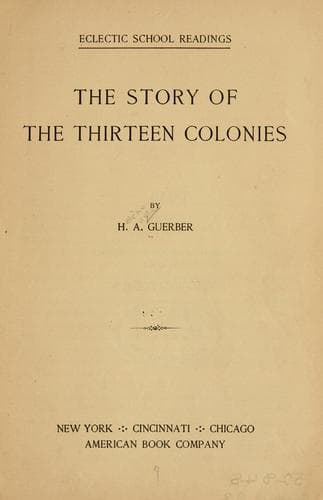
The Story of the Thirteen ColoniesGuerber, H. A. (Hélène Adeline)
History
The Story of the Thirteen Colonies
Guerber, H. A. (Hélène Adeline)
United States -- History -- Colonial period, ca. 1600-1775
The man who first spoke publicly against these search warrants, in
the old statehouse in Boston, was James O´tis. When he declared that
this was not right, he was told it was done in Great Britain as well
as in America. Otis then answered that, as the British had a share
in making that law, they were, of course, obliged to obey it. But he
added that the Americans had no seats in the British Par´lia-ment,
had had no share in making the law, and were therefore not bound to
respect it.
Many of the colonists agreed with Otis, so the British officers did
not dare offend them by making frequent visits to their houses; but
they kept ships along the coast to chase all suspicious vessels and
see whether they had any foreign goods on board. This proceeding was
almost as disagreeable to the colonists as searching their houses.
One of these boats, the _Gas´pee_, in pursuing a colonial vessel,
ran ashore in Narragansett Bay, Rhode Island, in 1772. Before it
could be worked off the shoal,--which is still known as Gaspee
Point,--a number of the best citizens of Providence came in disguise
and set fire to the ship. But although the British said their flag
had been insulted, and tried to find the guilty parties, they never
could lay hands upon them.
LVIII. THE STAMP TAX.
Besides the galling trade and navigation laws to which the poor
American colonists had to submit, there were other troubles which
you must try to understand. The French and Indian War had cost a
great deal of money, which had to be paid. It was also needful to
take steps to arrange for the government of the new territory, and
especially to defend it, for the British knew that the French and
Spaniards would like to get it back.
Now, King William's War, Queen Anne's War, and King George's War had
been waged because England and France were fighting in Europe. They
had done no good to the colonists, who, even after furnishing men
and money, and winning Louisburg, saw it given back to the French.
It was different, though, with the fourth war, which was begun in
America, while Great Britain furnished men, money, and arms to
defend the colonies. The colonies had done their best to help, and
the American soldiers, whom the British mockingly called "Yankee
Doodles," had shown great courage.
Franklin tried to arrange matters of taxation by his plan of
government, which, you remember, was set aside at Albany (1754). The
colonies refused it because they said it gave too much power to the
king; and the king refused to accept it because it gave too much
power to the colonies.
King George's advisers now told him that as Great Britain had run
into debt fighting in America, it was only right that the colonies
should help to pay the money. They added that it would be necessary
to keep an army in America to defend the new-won lands, and that
the colonies ought to feed and pay these soldiers.
Public-domain text, read in full here on John Shaqi.
Reviews
Reviews
No reviews yet
Be the first to share your thoughts on this work.
Elsewhere in the archive
Join the Discussion
Join the discussion
Sign in to leave a comment or review.
Sign InorCreate an account