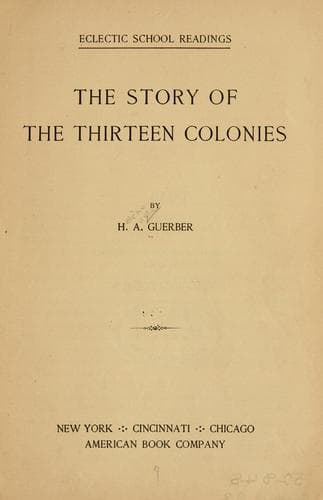
The Story of the Thirteen ColoniesGuerber, H. A. (Hélène Adeline)
History
The Story of the Thirteen Colonies
Guerber, H. A. (Hélène Adeline)
United States -- History -- Colonial period, ca. 1600-1775
If Great Britain had asked the colonies, "Will you support an army?"
they might perhaps have consented. But instead of letting the
Americans talk the matter over and raise the money in any way they
pleased, measures were taken by Parliament to raise a large sum,
which the king was to use in providing for a standing army.
At that time, many of the British were dissatisfied, too, for the
members of the House of Commons no longer represented the whole
nation. New cities like Bir´ming-ham, Man´ches-ter, and Leeds had
no right to vote at all, while a few tumble-down places, which had
been towns two hundred years before, still sent several members to
Parliament. Pitt and some other statesmen said that a new census
ought to be taken, and that the House of Commons should represent
all the people of Great Britain; but the king, among others, thought
things ought to remain just as they were.
The two parties were still quarreling over this when the question
about America came up, and it was greatly because the British were
not fairly represented that unjust laws were made. To raise the
money, Parliament decreed that the colonies would have to keep the
trade and navigation laws, and pay a tax upon sugar and molasses,
and that no newspaper should be printed or deed written except on
paper stamped by government officers. This was called the "Stamp
Act."
As soon as Pitt heard that the Stamp Act had been passed, he
said it was wrong to tax the colonies without their consent. But
Parliament would not listen to him. In those days, vessels crossed
the Atlantic only once a month. There was no telegraph, no daily
newspapers, and the post between large cities like Philadelphia
and New York ran only twice or thrice a week. It therefore took
some time before the news of the passing of the Stamp Act became
generally known in America.
Franklin, who was then in England, did his best to hinder the making
of such an unjust law. He was once asked whether the Americans
would be angry; and, hoping to make the British understand how
unreasonable they were, he told them this story: A Frenchman once
came running out of his house with a red-hot poker. He grasped an
Englishman, passing by, and said: "Let me run this poker through
you!" Of course the Englishman declined. Then the Frenchman said:
"Well, let me at least run it a few inches into your body." But when
the Englishman again refused, the Frenchman said, in an aggrieved
way: "If you won't let me do either, you should at least pay for the
trouble of heating this poker!"
Still, all Franklin's tact and good sense could not prevent the law
being passed, and he sadly wrote home: "The sun of liberty is set;
the Americans must light the lamp of industry and economy."
LIX. THE ANGER OF THE COLONIES.
Public-domain text, read in full here on John Shaqi.
Reviews
Reviews
No reviews yet
Be the first to share your thoughts on this work.
Elsewhere in the archive
Join the Discussion
Join the discussion
Sign in to leave a comment or review.
Sign InorCreate an account