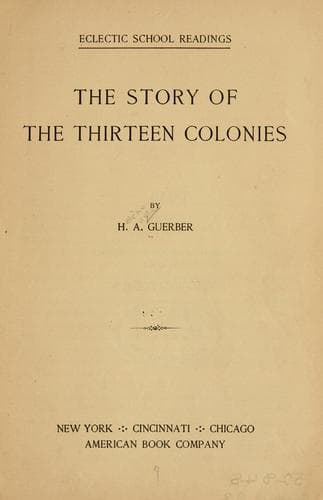
The Story of the Thirteen ColoniesGuerber, H. A. (Hélène Adeline)
History
The Story of the Thirteen Colonies
Guerber, H. A. (Hélène Adeline)
United States -- History -- Colonial period, ca. 1600-1775
One evening, therefore, Cornwallis gleefully told one of his
officers that they would "bag the old fox" on the next day. The
officer suggested that it might be better not to postpone it till
the morrow; but Cornwallis answered that this time the Americans
could not escape. That same night, however, Washington took
advantage of the fact that the roads froze hard enough to enable him
to remove his cannon, and slipped away by back roads, leaving his
camp fires burning brightly so as to deceive the enemy. When the
British awoke the next morning, the "old fox" was gone, and sounds
of firing in the direction of Prince´ton soon convinced them that a
battle must be going on there.
Running into Cornwallis's tent, an officer roused him, crying: "To
arms, general! Washington has outgeneraled us. Let us fly to the
rescue of Princeton!" But, notwithstanding all their haste, they
reached Princeton only after the battle--on the present college
grounds--was all over, and the victorious Washington had safely
advanced to Mor´ris-town Heights. This campaign, in the dead of
winter, was so wonderful that it won for Washington the title of
"Savior of his Country," and Frederick the Great of Prussia once
said that it was the most brilliant piece of generalship in the
pages of history.
LXIX. THE FIGHT AT BENNINGTON.
While Washington was spending the rest of the winter at Morristown,
the news of his triumphs reached France. Franklin had been sent
there, in 1776, to secure help, if possible. His reputation as a
man of science, his great talents, and his affable manners made
him a great favorite in Paris, where the fashionable ladies and
gentlemen carried fans and snuffboxes decorated with his portrait.
But although both king and queen received Franklin very graciously,
they would not at first promise him any aid.
A young French nobleman named La-fā-yette´, longing to help the
Americans, now decided to leave his young wife and home. But as the
king forbade him to leave court, he secretly embarked upon a vessel
he fitted out himself, and crossed the Atlantic. Then, as soon as
he landed, he went straight to Congress and offered to serve the
United States without pay. A few days later he met Washington, whose
helper he became, and who soon learned to love him as dearly as if
he had been his own son.
[Illustration: Washington and Lafayette.]
Several other illustrious foreigners came in the same way to fight
for America and freedom. The bravest among them were the Germans De
Kalb´ and Steu´ben, and the Poles Pu-las´kĭ and Kos-ci-us´ko. It is
said that when Kosciusko first presented himself, and was asked what
he could do, he briefly answered: "Try me." This reply so pleased
Washington that he made the young man his aid-de-camp.
Public-domain text, read in full here on John Shaqi.
Reviews
Reviews
No reviews yet
Be the first to share your thoughts on this work.
Elsewhere in the archive
Join the Discussion
Join the discussion
Sign in to leave a comment or review.
Sign InorCreate an account