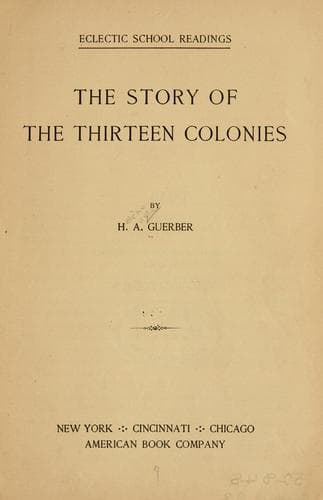
The Story of the Thirteen ColoniesGuerber, H. A. (Hélène Adeline)
History
The Story of the Thirteen Colonies
Guerber, H. A. (Hélène Adeline)
United States -- History -- Colonial period, ca. 1600-1775
Washington's victories at Trenton and Princeton, and his return
toward New York, could not divert Howe from his purpose to secure
Philadelphia. When summer came on, therefore, he set out with his
fleet to take that city. Washington began retracing his steps,
and, knowing that Howe could not sail up the Delaware,--which
was defended by forts,--went to meet him at Chadds Ford on the
Bran´dy-wine (1777). Here a battle was fought, and not only were the
Americans defeated, but Lafayette was sorely wounded.
Although beaten, Washington's army retreated in good order to
Philadelphia, which was soon taken by Howe and the British forces.
Hoping to drive them away, Washington surprised them, one morning,
at Germantown. Here he would have won a brilliant victory, had not a
dense fog made two divisions of his men shoot each other before they
discovered their mistake, thus creating a panic.
As there was nothing to be gained by fighting with exhausted troops,
Washington now withdrew, and before long went to Valley Forge for
the winter. Meanwhile, Howe attacked the forts on either side of the
Delaware River. One of these held out bravely for six days, refusing
to surrender until it had been battered to pieces. Then, as one fort
alone could not check the British fleet, the second surrendered also.
Hoping to damage some of the British vessels at Philadelphia, the
patriots made rude torpedoes, which were placed inside of small kegs
and sent floating down the river. One of these engines struck a cake
of ice and exploded, and the British, thus warned of danger, shot at
every floating object they saw, thus waging what has been called in
fun the "Battle of the Kegs."
The British, having nothing else to do, now settled down comfortably
in Philadelphia, where they lived on the very best of everything.
They spent most of their time giving balls and parties, and grew so
fat and lazy that, as Franklin wittily said, "Howe has not taken
Philadelphia so much as Philadelphia has taken Howe." This remark
proved true, for although the plan had been that Howe should march
northward, he was delayed by Washington until it was almost too
late. Besides, we are told that the British general never received
positive orders to go north, for the paper, being badly written, was
laid aside to be copied, and forgotten until too late.
Meanwhile the British again tried to carry out their plan of
invading New York from Canada. This time, while one army started
from Lake Ontario for the Mo´hawk valley, Burgoyne came southward
up Lake Champlain, with British and Indian troops, and took Forts
Ticonderoga and Edward. This was considered a great victory in
England, and when King George heard that Ticonderoga was taken, he
clapped his hands and shouted: "I have beat them! I have beat all
the Americans!"
Public-domain text, read in full here on John Shaqi.
Reviews
Reviews
No reviews yet
Be the first to share your thoughts on this work.
Elsewhere in the archive
Join the Discussion
Join the discussion
Sign in to leave a comment or review.
Sign InorCreate an account