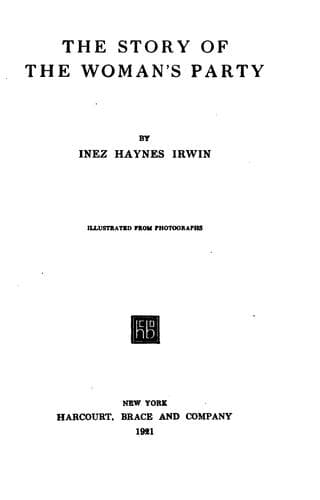
The Story of the Woman's PartyGillmore, Inez Haynes
History
The Story of the Woman's Party
Gillmore, Inez Haynes
National Woman's Party; Paul, Alice, 1885-1977; Women -- Suffrage -- United States
President Wilson said, in answer, that he could not interfere with the
action of Congress. He believed that Suffrage should be established on
the secure foundation of separate State action. “You should work from
the bottom up, not from the top down,” the President said. “Women should
be patient, and continue to work in the admirable way they have worked
in the past.”
* * * * *
On July 4, President Wilson reviewed a Labor parade in connection with
the laying of the corner-stone of the Labor Temple of the American
Federation of Labor in Washington, D. C., and at its close he addressed
the marchers. He had just declared that he stood for the interests of
all classes, when Mabel Vernon, who sat on the platform a few feet away,
called in a voice which has a notably clear, ringing quality, “Mr.
President, if you sincerely desire to forward the interests of all the
people, why do you oppose the national enfranchisement of women?”
The President answered, “That is one of the things which we will have to
take counsel over later.”
When the President was closing his speech, Mabel Vernon called again;
“Answer, Mr. President, why do you oppose the national enfranchisement
of women?”
The President did not answer.
The Secret Service men with almost an exquisite courtesy gently hurried
Miss Vernon away.
* * * * *
On July 24, another deputation of prominent Democratic women called on
the President. The deputation included Mrs. George W. Lamont, Harriot
Stanton Blatch, Mina Van Winkle, Helen Todd. I quote the _Suffragist_:
Mrs. Lamont, who introduced the group to President Wilson, said: “I
have come to you, Mr. President, as a Democratic woman. I used to be
first a Democrat and then a Suffragist; now I am a Suffragist
first.” She asked the President if he realized how painful a
position he created for Democratic women when he opposed the
enfranchisement of their sex and forced them to choose between their
Party allegiance and their loyalty to women throughout the nation.
Mrs. Blatch told President Wilson of the strength of the sentiment
for Woman Suffrage she had found in the West on her recent trip in
the Suffrage Special through the equal Suffrage States and of the
extraordinary difficulties she had experienced in her own life
trying to win Suffrage by amending the constitution of her State.
Public-domain text, read in full here on John Shaqi.
Reviews
Reviews
No reviews yet
Be the first to share your thoughts on this work.
Elsewhere in the archive
Join the Discussion
Join the discussion
Sign in to leave a comment or review.
Sign InorCreate an account