The Story of the Woman's PartyGillmore, Inez Haynes
History
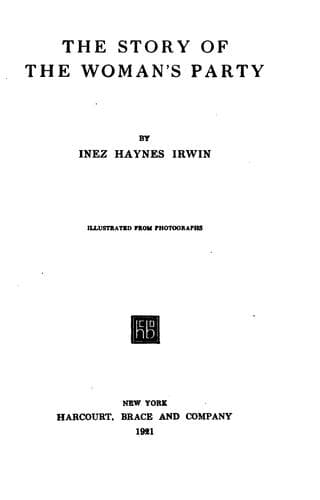
The Story of the Woman's Party
Gillmore, Inez Haynes
National Woman's Party; Paul, Alice, 1885-1977; Women -- Suffrage -- United States
“I am sixty years old, Mr. President,” said Mrs. Blatch, “I have
worked all my life for Suffrage; and I am determined that I will
never again stand up on the street corners of a great city appealing
to every Tom, Dick, and Harry for the right of self-government. When
we work for a Federal Amendment, we are dealing at last with men who
understand what we are talking about and can speak to us in our
tongue. We are not asking for an easy way to win the vote. It is not
easy to amend the United States Constitution. We are asking for a
dignified way; and we ought to be able to rely on the chivalry of
our representatives, particularly of the southern representatives,
to accord to women a self-respecting method of working out their
enfranchisement.”
Miss Helen Todd told the President of her experience in a State
campaign in Texas, when Democratic members of the Legislature
refused to submit the question to the voters, saying bluntly that
they controlled eleven votes in the upper house and that those
eleven could keep the Suffrage Amendment “tied up” indefinitely.
“Women go to Democrats in Congress and are told they must appeal to
State Legislatures. They go to Democratic State Legislatures, who
refuse to allow the electors of their own State to vote upon the
question at all. What are women to do, Mr. President?” said Miss
Todd, “when they are played with in this cat and mouse fashion?”
The interview was in many respects interesting. President Wilson did
not mention the States’ rights formula. He said he was unable to
help the Suffrage Amendment in Congress because his Party was
opposed to it. It was the President’s theory, he explained, that a
Party leader should not go so far in advance of his adherents as to
withdraw himself from them, and make united action impossible upon
the other issues before the country.
The impression was strongly conveyed, however, that this opposition
from the President’s Party was not necessarily permanent. “In four
years, or in two years,” said Mr. Wilson, impressively but vaguely,
“the situation might be different. At present many members of the
Democratic Party are opposed to Woman Suffrage on account of the
negro question.” “But,” said one of his visitors, “if women were
given the vote throughout the United States the percentage of the
white vote to the negro vote would be increased.” “You have not
explained that to the men in Congress,” President Wilson said.
Public-domain text, read in full here on John Shaqi.
Reviews
Reviews
No reviews yet
Be the first to share your thoughts on this work.
Elsewhere in the archive
Join the Discussion
Join the discussion
Sign in to leave a comment or review.
Sign InorCreate an account