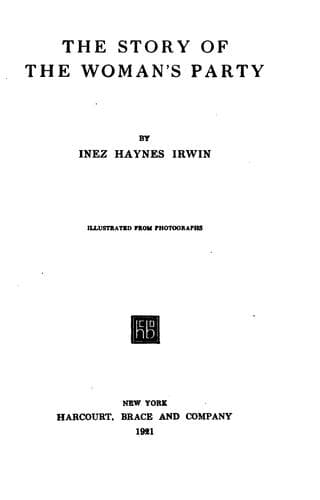
The Story of the Woman's PartyGillmore, Inez Haynes
History
The Story of the Woman's Party
Gillmore, Inez Haynes
National Woman's Party; Paul, Alice, 1885-1977; Women -- Suffrage -- United States
Behind there came hundreds of women bearing the purple, white, and gold.
They were divided according to States; and before each division marched
the State flag of the division. The drenching rain fell steadily. The
pavements turned to shallow lakes, and the banners—their brilliancy
accentuated by the wet—threw long, wavy reflections on the glassy, gray
streets. They were of course expecting this demonstration at the White
House, and, as though it were dangerous, unusual precautions had been
taken against it. Every gate was locked. The Washington force of police
officers, augmented by police from Baltimore and by squads of
plain-clothes men, guarded the grounds without and within. Gilson
Gardner said the President seemed to think the women were going to steal
his grass roots.
There was no one at the locked gates to receive the women or the
resolutions except the guards; these guards protested that they had not
been ordered to receive either. The women visited every gate, but
received the same answer. The cards of the leaders were finally handed
over to a guard to present at the White House. He tried to deliver them,
but was reprimanded for leaving his post, and sent back. Learning that
the cards would be delivered at the end of the day, as is the custom
with visiting-cards of casual visitors at the White House, the thousand
pickets took up their march again.
Gilson Gardner wrote of this demonstration:
The weather gave this affair its character. Had there been fifteen
hundred women carrying banners on a fair day, the sight would have
been a pretty one. But to see a thousand women—young women,
middle-aged and old women—and there were women in the line who had
passed their three score and ten—marching in a rain that almost
froze as it fell; to see them standing and marching and holding
their heavy banners, momentarily growing heavier—holding them
against a wind that was half gale—hour after hour, until their
gloves were wet, their clothes soaked through; to see them later
with hands sticky from the varnish from the banner poles—bare hands,
for the gloves had by this time been pulled off, and the hands were
blue with cold—to see these women keep their lines and go through
their program fully, losing only those who fainted or fell from
exhaustion, was a sight to impress even the dulled and jaded senses
of one who has seen much.
One young woman from North Dakota I saw clinging to the iron pickets
around the White House, her banner temporarily abandoned, fighting
against what was to her a new feeling, faintness resulting from the
pain in her hands. She was brought to the automobile in which I was
riding before she actually fell to the ground; but after a short
rest she was back in the line, and finished with the others.
There is no doubt that what Gilson Gardner said was true—the weather
gave this affair its character.
Public-domain text, read in full here on John Shaqi.
Reviews
Reviews
No reviews yet
Be the first to share your thoughts on this work.
Elsewhere in the archive
Join the Discussion
Join the discussion
Sign in to leave a comment or review.
Sign InorCreate an account