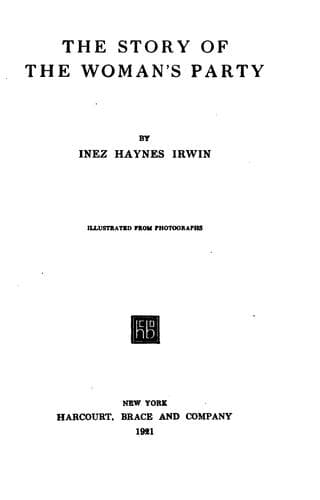
The Story of the Woman's PartyGillmore, Inez Haynes
History
The Story of the Woman's Party
Gillmore, Inez Haynes
National Woman's Party; Paul, Alice, 1885-1977; Women -- Suffrage -- United States
People passing by, thrilled by the gallantry of the marchers, joined the
procession. And as Gilson Gardner says, it was not because it was a
pretty sight, or because these women were all young. Anna Norris Kendall
of Wisconsin, seventy-two years old, and the Rev. Olympia Brown,
eighty-two years old, one of the pioneer Suffragists of the country,
both took part.
[Illustration: THE THOUSAND PICKETS TRY VAINLY TO DELIVER THEIR
RESOLUTIONS TO THE PRESIDENT, MARCH 4, 1917.]
[Illustration: A THOUSAND PICKETS MARCHING AROUND THE WHITE HOUSE, MARCH
4, 1917.]
That day, a newly elected Congressman drove about Washington, showing
the city to his wife. He had always been a Suffragist. She had always
been an anti-Suffragist. The sudden sight of the thousand women marching
in the rain not only converted her, but it produced such an effect on
her she burst into tears.
* * * * *
Later, President Wilson sent a letter to the National Woman’s Party,
acknowledging the resolutions presented to him by the deputations of
March 4, and concluded: “May I not once more express my sincere interest
in the cause of Woman Suffrage?”
* * * * *
Congress adjourned on March 3, 1917. The pickets adjourned with it. On
April 2, a Special War Session of Congress convened. The _Suffragist_
gives an interesting description of that interesting day.
Just half an hour before Congress formally opened, the Suffrage
sentinels at the Capitol took their places.... There was tensity in
the atmosphere. The Capitol grounds were overrun with pacifists from
many cities wearing white-lettered badges; and with war advocates,
as plainly labeled, with partisan demands. They swarmed over the
Capitol grounds unmolested, though extra precautions were taken
throughout the day and in the evening when troops of cavalry were
called out. The silent sentinels stood unmoved the while for
democracy while peace and war agitation eddied around them.
The pickets convened with Congress. They continued to stand at the gates
of the White House, but they extended their line to the Capitol. Three
pickets, led by Elsie Hill, took up their station by the House entrance
and three by the Senate entrance. At night—this evoked from the
newspapers sly allusions to the Trojan horse—they used to store their
banners in the House Office Building.
On April 7, the United States declared itself to be at war with Germany.
* * * * *
Public-domain text, read in full here on John Shaqi.
Reviews
Reviews
No reviews yet
Be the first to share your thoughts on this work.
Elsewhere in the archive
Join the Discussion
Join the discussion
Sign in to leave a comment or review.
Sign InorCreate an account