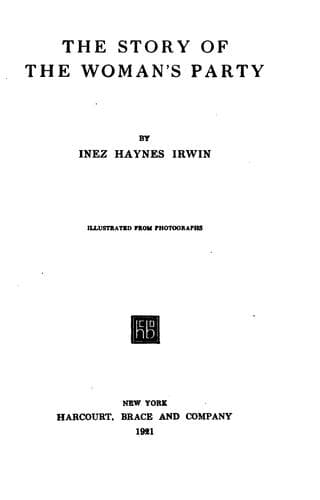
The Story of the Woman's PartyGillmore, Inez Haynes
History
The Story of the Woman's Party
Gillmore, Inez Haynes
National Woman's Party; Paul, Alice, 1885-1977; Women -- Suffrage -- United States
As for the White House guards—they were the champions of the pickets. At
the outbreak of the war, the White House gates were closed for the first
time in its history. The pickets without often informed the guards
within as to the kind of vehicle that demanded entrance of them. The
guards came to treat them as comrades patrolling the same beat. Once,
when the pickets were five minutes late, one of these guards said: “We
thought you weren’t coming, and we’d have to hold down this place
alone.”
When the pickets reconvened with the Special War Session of the
Sixty-fifth Congress on April 2, the White House police were most
demonstrative in their welcome. They were glad to see them back: they
said they had missed them. And indeed they had come to look on the women
as a kind of auxiliary police force. Once, when somebody asked a
policeman, “When is the President coming out?” Mary Gertrude Fendall
said, “I guess you’d like a dollar for every time people ask you that.”
The policeman answered, “I’d rather have a dollar for every time they
ask when are the Suffragists coming out?” The country at large had
accepted the pickets. The directors of the sight-seeing busses pointed
them out as one of the city’s sights. Tourists said, oftener and
oftener, “Well, we weren’t quite sure where the White House was until we
saw you pickets.” And when these tourists used to crowd about the gates,
waiting for the President’s limousine to come out, and the signal was
flashed that the Presidential motor had started, the guards pressed the
crowds away. “Back!” they would order. “Back! Back! All back but the
pickets! No one allowed inside the line but the pickets!”
As can be imagined, Headquarters was a busy place during the picketing;
and sometimes a hectic one. Later, of course, when the arrests began,
and mobs besieged it, it seethed with excitement. It was not easy always
to find women with the leisure and the inclination to serve on the
picket line before the arrests. But, when arrests began and
imprisonments followed, naturally it became increasingly difficult.
Many members of the Woman’s Party in Washington looked on their
picketing as a part of the day’s work. Mrs. William Kent, who said that
no public service she had ever done gave her such an exalted feeling,
always excused herself early from teas on Monday. “I picket Mondays from
two to six,” she explained simply.
* * * * *
Watchers said that those high groups of purple, white, and gold banners
coming down the streets of Washington were like the sails, magically
vivid and luminous, of some strange ship. They were indeed the sails of
a ship—the mightiest that women ever launched—but only the women who
manned those sails saw that ship.
_3. The War on the Pickets_
“I have no son to give my country to fight for democracy abroad and
so I send my daughter to Washington to fight for democracy at home.”
Public-domain text, read in full here on John Shaqi.
Reviews
Reviews
No reviews yet
Be the first to share your thoughts on this work.
Elsewhere in the archive
Join the Discussion
Join the discussion
Sign in to leave a comment or review.
Sign InorCreate an account