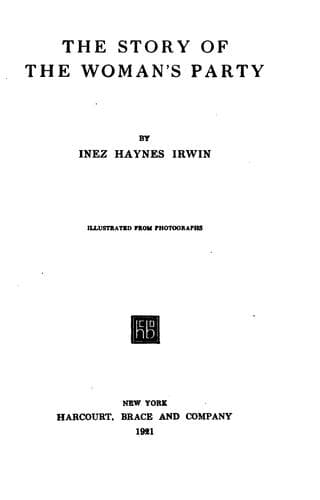
The Story of the Woman's PartyGillmore, Inez Haynes
History
The Story of the Woman's Party
Gillmore, Inez Haynes
National Woman's Party; Paul, Alice, 1885-1977; Women -- Suffrage -- United States
J. A. H. Hopkins, who had been a member of the Democratic National
Campaign Committee of 1916, went immediately to the President and told
him the conditions under which these women were being held. Gilson
Gardner, a well-known newspaper man who had supported Wilson throughout
the previous election campaign, wrote a long communication to the
President on the same subject. Dudley Field Malone, Collector of the
Port of New York and one of the President’s closest friends and warmest
advisors, who was later in so gallant a way to show his disapproval of
the Suffrage situation, saw the President also. President Wilson
professed himself as being “shocked” at his revelations. He said he did
not know what was going on at Occoquan.
“After this, Mr. President,” Mr. Malone replied, “you _do_ know.”
* * * * *
After her release, Mrs. J. A. H. Hopkins wanted to find out whether this
pardon also meant that the President supported their Amendment. She
therefore wrote him the following letter:
MY DEAR MR. PRESIDENT:
The pardon issued to me by you is accompanied by no explanation. It
can have but one of two meanings—either you have satisfied yourself,
as you personally stated to Mr. Hopkins, that I violated no law of
the country, and no ordinance of this city, in exercising my right
of peaceful petition, and therefore you, as an act of justice,
extended to me your pardon, or you pardoned me to save yourself the
embarrassment of an acute and distressing political situation.
In this case, in thus saving yourself, you have deprived me of the
right through appeal to prove by legal processes that the police
powers of Washington despotically and falsely convicted me on a
false charge, in order to save you personal or political
embarrassment.
As you have not seen fit to tell the public the true reason, I am
compelled to resume my peaceful petition for political liberty. If
the police arrest me, I shall carry the case to the Supreme Court if
necessary. If the police do not arrest me, I shall believe that you
do not believe me guilty. This is the only method by which I can
release myself from the intolerable and false position in which your
unexplained pardon has placed me.
Mr. Hopkins and I repudiate absolutely the current report that I
would accept a pardon which was the act of your good nature.
In this case, which involves my fundamental constitutional rights,
Mr. Hopkins and myself do not desire your Presidential benevolence,
but American justice.
Furthermore, we do not believe that you would insult us by extending
to us your good-nature under these circumstances.
This pardon without any explanation of your reasons for its
issuance, in no way mitigates the injustice inflicted upon me by the
violation of my constitutional civil right.
Respectfully yours,
Public-domain text, read in full here on John Shaqi.
Reviews
Reviews
No reviews yet
Be the first to share your thoughts on this work.
Elsewhere in the archive
Join the Discussion
Join the discussion
Sign in to leave a comment or review.
Sign InorCreate an account