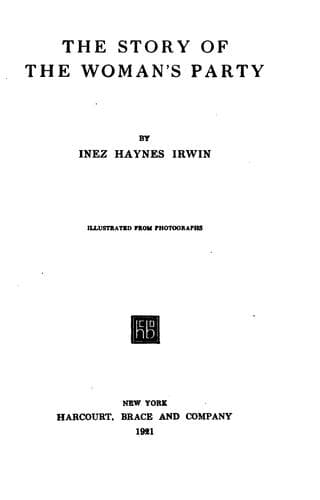
The Story of the Woman's PartyGillmore, Inez Haynes
History
The Story of the Woman's Party
Gillmore, Inez Haynes
National Woman's Party; Paul, Alice, 1885-1977; Women -- Suffrage -- United States
The next day, August 15, was only a degree less violent. The Suffrage
pickets went on duty as usual at twelve o’clock, and picketed all that
afternoon.
All the afternoon yeomen, small boys, and hoodlums attacked the women
without hindrance. Elizabeth Stuyvesant was struck by a soldier who
destroyed her flag. Beulah Amidon was thrown down by a sailor, who stole
her flag. Alice Paul was knocked down three times. One sailor dragged
her thirty feet along the White House sidewalk in his attempts to tear
off her Suffrage sash, gashing her neck brutally. They were without
protection until five o’clock.
During this time they lost fifty tri-color banners and one Kaiser
banner.
The pickets were, of course, constantly going back to Headquarters for
new banners, and constantly returning with them.
At five o’clock, in anticipation of the President’s appearance, and
while still the turmoil was going on, five police officers quickly and
efficiently cleared a wide aisle in front of each gate, and as quickly
and as efficiently drove the mob across the street. The President,
however, left by a rear gate.
On the next day, August 16, the policy toward the pickets changed again.
Fifty policemen appeared on the scene, and instead of permitting
Suffragists to be attacked by others, they attacked them themselves.
Virginia Arnold was set upon by three police officers. Before she could
relinquish her banner to them, her arms were twisted and her hands
bruised. Elizabeth Stuyvesant, Natalie Gray, and Lucy Burns were all
severely handled by the police. Elizabeth Smith and Ruth Crocker, who
were carrying furled flags, were knocked down. When men, more
chivalrous-minded than the crowd, came to their rescue, they were
arrested.
In the late afternoon, the crowd grew denser. The police, therefore,
ceased their efforts, and waited while the crowd attacked the women and
destroyed their banners An officer threatened to arrest one young woman
who defended her banner against an assailant.
“Here, give that up!” called the second officer to a girl who was
struggling with a man for the possession of her flag.
During these days of mob attacks, the pickets had been put to it to get
outside Headquarters to some coign of vantage where they could stand for
a few seconds before the inevitable rush. For the first time in the
history of their picketing the girls could not carry their banners on
poles. Either the mobs seized them or the policemen who lined the
sidewalks outside Headquarters. The pickets carried them inside their
sweaters and hats, in sewing bags, or pinned them, folded in newspapers
or magazines, under their skirts. One picket was followed by crowds who
caught a gleam of yellow at the hem of her gown. When they got to the
White House, the pickets held the banners in their hands. Lucy Burns
kept sending out relays with new banners to take the place of those
which were torn.
Public-domain text, read in full here on John Shaqi.
Reviews
Reviews
No reviews yet
Be the first to share your thoughts on this work.
Elsewhere in the archive
Join the Discussion
Join the discussion
Sign in to leave a comment or review.
Sign InorCreate an account