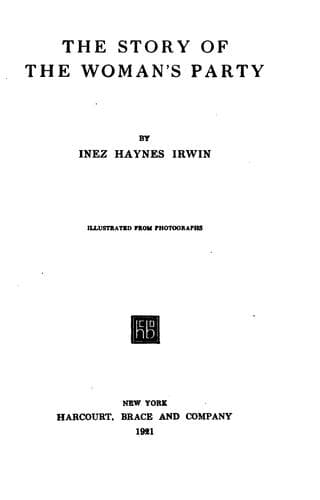
The Story of the Woman's PartyGillmore, Inez Haynes
History
The Story of the Woman's Party
Gillmore, Inez Haynes
National Woman's Party; Paul, Alice, 1885-1977; Women -- Suffrage -- United States
To these pleas, Judge Pugh answered that the President was “not the one
to petition for justice”; that the people of the District virtuously
refrained from picketing the White House for the vote for themselves
“for fear the military would take possession of the streets.”
I quote the _Suffragist_ of September 2.
Here is a sample of Judge Pugh’s logic:
“These ladies have been told repeatedly that this law was ample to
prevent picketing in front of the White House, or anywhere else on
the sidewalks of the District of Columbia; that it was not the
fashion to petition Congress in that way, to stand in front of the
White House, the President’s mansion, to petition somebody else, a
mile and a half away. The President does not have to be
petitioned.... You ladies observe all the laws that give you
benefits, property rights that legislatures composed of men have
passed ... and those that are aimed at preserving the peace and good
order of the community you do not propose to observe.”
And much more to the same effect, which proved that Judge Pugh knew
nothing of the long vigil of the pickets at the doors of Congress,
and apparently nothing of the President’s actual dictatorship.
Finally he admitted that he did not care to send “ladies of
standing” to jail, and would refrain if they promised to stop
picketing, although they were not charged with picketing. In the
face of the dead silence that followed, he pronounced sentence: A
fine of twenty-five dollars or thirty days at Occoquan Workhouse.
Every woman refused to pay the fine.
Attorney Matthew O’Brien represented the women in the District
Court, appealing finally from the judgment of the court.
On August 28, the same women, with Cornelia Beach, Vivian Pierce, Maud
Jamison, and Lucy Burns, were again arrested, and given the same
sentence. An appeal was granted them again, the Judge announcing that
this was the last appeal he would give in the picketing cases until a
decision had been given by the Court of Appeals.
* * * * *
On September 4, the day of the parade of the drafted men, thirteen women
were arrested. They were: Abby Scott Baker, Dorothy Bartlett, Annie
Arniel, Pauline Adams, Mrs. W. W. Chisholm, Lucy Burns, Margaret
Fotheringham, Lucy Branham, Julia Emory, Eleanor Calnan, Edith Ainge,
Maude Malone, Mary Winsor.
The banner these women bore was inscribed:
MR. PRESIDENT, HOW LONG MUST WOMEN BE DENIED A VOICE
IN THE GOVERNMENT THAT IS CONSCRIPTING THEIR SONS?
They were sent to Occoquan for sixty days.
At this vivid interval in the history of the Woman’s Party occurred a
notable incident.
Public-domain text, read in full here on John Shaqi.
Reviews
Reviews
No reviews yet
Be the first to share your thoughts on this work.
Elsewhere in the archive
Join the Discussion
Join the discussion
Sign in to leave a comment or review.
Sign InorCreate an account