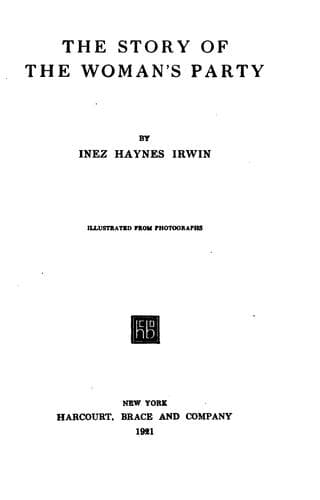
The Story of the Woman's PartyGillmore, Inez Haynes
History
The Story of the Woman's Party
Gillmore, Inez Haynes
National Woman's Party; Paul, Alice, 1885-1977; Women -- Suffrage -- United States
At intervals of fifteen minutes—for two hours—the pickets were told by a
captain of police that they would be arrested if they did not move. But
they held their station. At half-past four, the hour at which the
thousand of government clerks invade the streets, there was enough of a
crowd to give the appearance that the pickets were “blocking traffic.”
Lavinia Dock; Edna Dixon; Natalie Gray; Madeline Watson; Catherine
Flanagan; Lucy Ewing, were arrested soon after four o’clock. Their trial
lasted just forty minutes. One police officer testified that they were
obstructing traffic. They all refused to pay the ten-dollar fine, which,
though it would have released them, would also have been an admission of
guilt, and Police Magistrate Pugh sentenced them to serve thirty days in
the Government Workhouse.
* * * * *
On August 23, six women appeared at the White House, bearing banners.
They were, Pauline Adams; Gertrude Hunter; Clara Fuller; Kate Boeckh;
Margaret Fotheringham; Mrs. Henry L. Lockwood. All of their banners
quoted words from the President’s works:
I TELL YOU SOLEMNLY, LADIES AND GENTLEMEN, WE CANNOT
POSTPONE JUSTICE ANY LONGER IN THESE UNITED
STATES, AND I DON’T WISH TO SIT DOWN AND LET ANY MAN
TAKE CARE OF ME WITHOUT MY HAVING AT LEAST A VOICE IN
IT; AND IF HE DOESN’T LISTEN TO MY ADVICE I AM GOING TO
MAKE IT AS UNPLEASANT FOR HIM AS I CAN.
In ten minutes they were all arrested. When they appeared before Police
Magistrate Pugh, Clara Kinsley Fuller said in part:
I am the editor, owner, and publisher of a daily and weekly
newspaper in Minnesota. I pay taxes to this government, yet I have
nothing to say in the making of those laws which control me, either
as an individual or as a business woman. Taxation without
representation is undemocratic. For that reason, I came to
Washington to help the Federal Amendment fight. When I learned that
President Wilson said that picketing was perfectly legal, I went on
the picket line and did my bit towards making democracy safe at
home, while our men are abroad making democracy safe for the world.
Margaret Fotheringham, a school-teacher, said:
I have fifteen British cousins who are in the fighting line abroad.
Some are back very badly wounded, and others are still in France. I
have two brothers who are to be in our fighting line. They were not
drafted; they enlisted. I am made of the same stuff that those boys
are made of; and, whether it is abroad or at home, we are fighting
for the same thing. We are fighting for the thing we hold nearest
our hearts—for democracy.
Public-domain text, read in full here on John Shaqi.
Reviews
Reviews
No reviews yet
Be the first to share your thoughts on this work.
Elsewhere in the archive
Join the Discussion
Join the discussion
Sign in to leave a comment or review.
Sign InorCreate an account