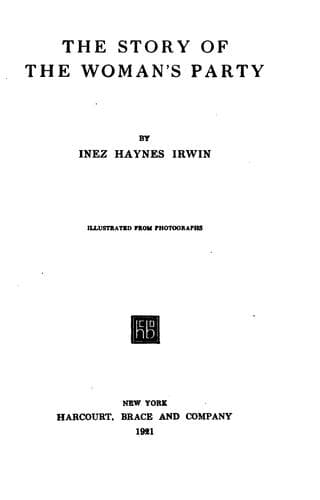
The Story of the Woman's PartyGillmore, Inez Haynes
History
The Story of the Woman's Party
Gillmore, Inez Haynes
National Woman's Party; Paul, Alice, 1885-1977; Women -- Suffrage -- United States
I didn’t know at the time what happened to the other women. I only
knew that it was hell let loose with Whittaker as the instigator of
the horror. In the ante-chamber to the cells, some of the guards
were standing, swinging night sticks in a menacing manner. We were
thrust into cells; the ventilators were closed. The cells were
bitter cold. There was an open toilet in the corner of the cell,
which was flushed from the outside. We had to call a guard who had
previously attacked us to flush them. The doors were barred, there
were no windows. The doors were uncurtained, so that through the
night the guard could look into the cell. There was no light in the
room, only one in the corridor. Three of us were thrown into every
cell. There was a single bed in each room and a mattress on the
floor. The floors were filthy as were the blankets.
In the morning, we were roughly told to get up. No facilities for
washing were given us. Faint, ill, exhausted, we were ordered before
the superintendent. It was eight o’clock and we had had no food
since the preceding day at twelve. None had been offered us, nor
were any inquiries made about our physical condition. Whittaker
asked my name; then whether I would go to the Workhouse and obey
prison regulations and be under the care of the ladies. I told him I
would not. I would not wear prison clothes, and I demanded the
rights of political prisoners. He interrupted me with, “Then you’ll
go to the male hospital”—he emphasized the “male”—“and be in
solitary confinement. Do you change your mind?” I said “No!” and was
taken to the hospital by a trusty.
Then followed a series of bullying, of privileges, and of curtailing
them. The first day at three o’clock milk and bread were brought to
the room. After I refused it, it was taken away. That evening some
more milk and bread were brought. These were left in the room all
night. The second day toast and milk were brought. These were left
in the room all night. The third day the matron suggested an egg and
coffee for breakfast. I told her I did not want anything to eat.
This day at lunch time fried chicken and salad were brought in.
Later Miss Burns passed a note which read, “I think this riotous
feast which has just passed our doors is the last effort of the
institution to dislodge all of us who can be dislodged. They think
there is nothing in our souls above fried chicken.” No matter what
was offered, a glass of milk and piece of bread were left from meal
to meal, and once bouillon and bread was left.
Public-domain text, read in full here on John Shaqi.
Reviews
Reviews
No reviews yet
Be the first to share your thoughts on this work.
Elsewhere in the archive
Join the Discussion
Join the discussion
Sign in to leave a comment or review.
Sign InorCreate an account