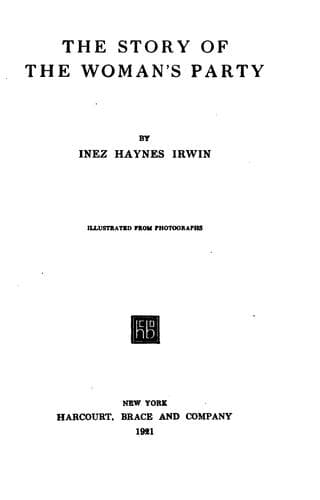
The Story of the Woman's PartyGillmore, Inez Haynes
History
The Story of the Woman's Party
Gillmore, Inez Haynes
National Woman's Party; Paul, Alice, 1885-1977; Women -- Suffrage -- United States
Whittaker will use these interviews in expurgated form, I am sure.
When I said anything which did not please him, he said to the
stenographer, “You needn’t put that down.”
After the above interviews, he absolutely refused to let our counsel
who came from Washington see us.
After my visit to Whittaker this day, I was summoned to the
Workhouse. My clothes were listed—those I wore—before two matrons,
just as those of criminals are listed; then I was obliged to undress
before the two matrons and two trusties, walk to a shower, take a
bath, and dress before them in prison clothes. The clothes were
clean, but so coarse that they rubbed my skin quite raw. They have
two sizes of shoes for the prisoners—large and small.
The only message which reached me from “outside” was a telegram from
a friend asking that I allow my bail to be paid. I answered that I
would not. This day six girls in our section were taken away
“somewhere.” The sense of some unknown horror suddenly descending is
the worst of the whole situation. Whittaker’s suave manner was
interrupted for a moment this day when he came into the hospital
ward and saw Julia Emory in the corridor—she was returning from the
wash-room—and taking Julia by the neck he threw her into her cell.
“Get in there,” he snarled, or words to that effect.... I was coming
out of an adjoining wash-room at the moment, and saw this.
This night I had a most vivid dream. The interne brought in a
rabbit. He held it up and told us he would cook it for us. The
women—our women—did not wait for him to cook it, but rushed toward
him, pulled it from his hands, and tore the living animal into
pieces and ate it. I awoke, sobbing.
Next evening, there was great commotion in our corridor. The doors,
which did not lock, were held; there were rapid footsteps to and
fro. Distressed sounds came from the room adjoining mine, and soon
it was evident that Miss Burns was being forcibly fed. Half an hour
earlier, her condition was found normal by the doctor, who strolled
casually through our ward, looked in at the door, nodded, felt her
pulse, and went on. Now Miss Burns was being forcibly fed. What
could it mean? Then there were more hurried steps, and the men went
to Mrs. Lewis’s room. Fifteen minutes later, they were both hurried
into an ambulance and taken away—no one told us where. We had
visions accentuated that night, of being separated, hurried out of
sight to oblivion, somewhere away from every one we knew.
A detachment of the United States Marines guarded the place. The
prisoners were kept incommunicado. That meant, not only were they not
allowed visitors, but they were not allowed counsel—and counsel is one
of the inalienable rights of citizenship.
Public-domain text, read in full here on John Shaqi.
Reviews
Reviews
No reviews yet
Be the first to share your thoughts on this work.
Elsewhere in the archive
Join the Discussion
Join the discussion
Sign in to leave a comment or review.
Sign InorCreate an account