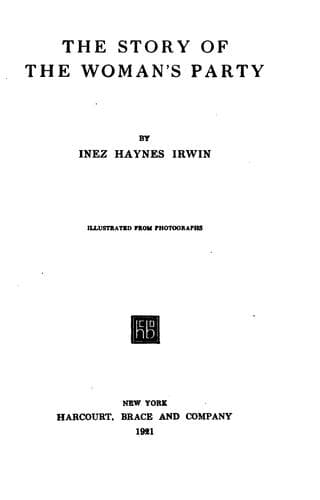
The Story of the Woman's PartyGillmore, Inez Haynes
History
The Story of the Woman's Party
Gillmore, Inez Haynes
National Woman's Party; Paul, Alice, 1885-1977; Women -- Suffrage -- United States
At Chattanooga, Joy Young had explained the situation; The Mayor was
with them; the Bar Association, the Chief of Police, the Sheriff were
against them; so the Mayor with the assistance of Labor and the
newspapers took up their fight. No hall was to be had, _and someone in
the Bar Association instructed the Chief of Police to enter any private
house and break up any meeting the Suffragists might hold; and the
Sheriff to do the same in the country outside the city limits_. But
Labor was not to be outwitted. They were holding a scheduled meeting in
their own hall that night. Labor canceled that meeting and offered Maud
Younger the hall free. They said they would like to see any police break
up a meeting in _their_ hall. All day long there was a stormy session of
the Commissioners as to whether or not she might speak. But in the end
she did speak.
* * * * *
Later, when Maud Younger returned to Washington, she met Senator
McKellar in the course of her lobbying activities. Of course, she was
astute enough to know that orders for all this persecution had come from
above. She referred quite frankly to his efforts to stop her in
Tennessee. With equal frankness, Senator McKellar said: “I wasn’t going
to have you talking against the President in Tennessee.”
------------------------------------------------------------------------
III
MORE PRESSURE ON CONGRESS
THE various activities described in the last six chapters all took place
in the year 1917. But during all this year—when the picketing, the
arrests, the imprisonments, were going on—work with Congress was of
course proceeding parallel with it. It now becomes necessary to go back
to the very beginning of the year to follow that work.
It will be remembered that early in this year there occurred in
Washington an event of national political importance. The Congressional
Union for Woman Suffrage and the Woman’s Party merged into one
organization.
This union of the Congressional Union with the Woman’s Party occurred on
March 2. On March 3—the last day of his first Administration—President
Wilson despatched the following letter to the Hon. W. R. Crabtree, a
member of the Tennessee Legislature.
May I not express my earnest hope that the Senate of Tennessee will
reconsider the vote by which it rejected the legislation extending
the Suffrage to women? Our Party is so distinctly pledged to its
passage that it seems to me the moral obligation is complete.
WOODROW WILSON.
On April 26 occurred a hearing before the Senate Committee; Anne
Martin presided. The note she struck in her opening speech sounded
all through the hearing—the somber, sinister note of the Great War;
and the necessity of accepting the Suffrage Amendment as a war
measure.
Public-domain text, read in full here on John Shaqi.
Reviews
Reviews
No reviews yet
Be the first to share your thoughts on this work.
Elsewhere in the archive
Join the Discussion
Join the discussion
Sign in to leave a comment or review.
Sign InorCreate an account