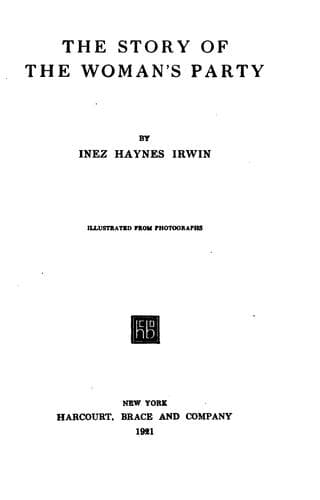
The Story of the Woman's PartyGillmore, Inez Haynes
History
The Story of the Woman's Party
Gillmore, Inez Haynes
National Woman's Party; Paul, Alice, 1885-1977; Women -- Suffrage -- United States
In Knoxville, they met with the same hostility from the Bar Association.
Their permit to speak in the town hall was revoked, and even the street
was denied to them. Joy Young, thereupon, went to Labor. The local Labor
leader, who was the editor of the Labor paper, saw at once that it was a
free speech fight. He said that Labor would make the fight for the
Suffragists. He also pointed out that though the Mayor was a Democrat,
the Judge was a Republican. He went to the Judge and asked for the Court
House. The Judge said that it was not within his power to grant the
Court House; that three county officials, to whom, twelve years before,
jurisdiction in this matter had been given, must decide the question.
These county officials agreed to the proposition. Again the Bar
Association interfered. All day long telephone pressure, pro and con,
was brought to bear on these county officials. In the end it was decided
to have a preliminary rehearsal of Miss Younger’s speech.
At high noon, therefore, Maud Younger went to the Court House. The
prosecuting attorney opened the proceedings by reading from a big book
an unintelligible excerpt on sedition. Miss Younger then made her
forceful, witty, and tactful speech. Of course they gave her the Court
House. The prosecuting attorney said, “For an hour I argued against you
with the Judge. Now, I don’t see how he could possibly refuse.” The
Judge said, “You women have a very real grievance.” Late as it was, Joy
Young got out dodgers, inviting the town to the meeting and scattered
them everywhere, and the afternoon papers carried the announcement.
That night at dinner, the editor of the Labor paper called. He told them
that the Sheriff had suddenly put up the claim of jurisdiction over the
county Court House taken from him twelve years ago, and that he would be
there with a band of armed deputies. “_But_,” said the Labor leader,
“_Labor will be there with eighty armed Union men to meet them_.” Of
course the two Woman’s Party speakers did not know what would happen.
But the only thing they did know was that they would hold the meeting as
usual. So Maud Younger and Joy Young proceeded alone to the Court House.
They both expected to be shot. The Sheriff with his deputies, instead of
surrounding the building, went inside, holding the place against
Suffrage attack. The Labor men stationed themselves in front of the
door. The steps were filled with audience. Joy Young introduced the
speaker. Maud Younger took up her position, and they held their meeting
outside. Miss Younger always says: “The Sheriff had the Court House, but
I had the audience.”
Public-domain text, read in full here on John Shaqi.
Reviews
Reviews
No reviews yet
Be the first to share your thoughts on this work.
Elsewhere in the archive
Join the Discussion
Join the discussion
Sign in to leave a comment or review.
Sign InorCreate an account