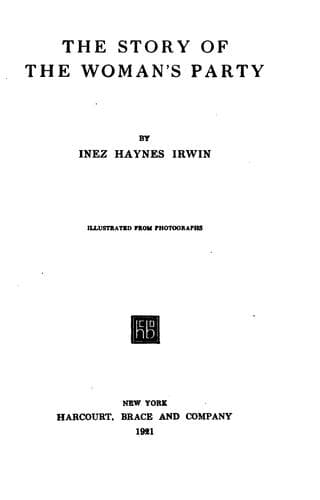
The Story of the Woman's PartyGillmore, Inez Haynes
History
The Story of the Woman's Party
Gillmore, Inez Haynes
National Woman's Party; Paul, Alice, 1885-1977; Women -- Suffrage -- United States
From 1916 on, the years in which Maud Younger was in charge of the lobby
committee, twenty-two Senators changed their position in favor of
Suffrage.
I have said that it was difficult for a Congressman to elude these swift
and determined scouts of the Woman’s Party. But harder still was it to
elude a something, an unknown quality—an x—which had come into the
fourth generation of women to demand enfranchisement. That quality was
political-mindedness. Congressmen had undoubtedly before run the gamut
of feminine persuasiveness; grace; charm; tact. But here was an army of
young Amazons who looked them straight in the eye, who were absolutely
informed, who knew their rights, who were not to be frightened by
bluster, put off by rudeness, or thwarted either by delay or political
trickery. They never lost their tempers and they never gave up. They
never took “No” for an answer. They were young and they believed they
could do the impossible. And believing it, they accomplished it. Before
the six years and a half of campaign of the Woman’s Party was over,
Congressman after Congressman, Senator after Senator paid tribute—often
a grudged one—to the verve and _élan_ of that campaign.
But though they talked man fashion, eye to eye, the lobbyists, when
returned to Headquarters, were full of excellent information and
suggestions and all that mysterious by-product which comes from feminine
intuition.
------------------------------------------------------------------------
III
ORGANIZING
ALTHOUGH it is impossible to do justice to any department of the
National Woman’s Party, it seems particularly difficult in the case of
the organizers. The reason for this is not far to seek. These young
women were turned loose, sometimes quite inexperienced; sometimes only
one to a State, with the injunction to come back with their shield or on
it. They always came back with their shield—that is to say an
organization of some sort in the State they had just left. As has been
before stated, the National Woman’s Party has organized in every State
in the Union at some time during its history—that is between the years
1912 and 1919. As has also been stated, the organizers divided into
three groups—those who worked in the first two years; those who worked
in the middle two; those who worked in the last two.
Public-domain text, read in full here on John Shaqi.
Reviews
Reviews
No reviews yet
Be the first to share your thoughts on this work.
Elsewhere in the archive
Join the Discussion
Join the discussion
Sign in to leave a comment or review.
Sign InorCreate an account