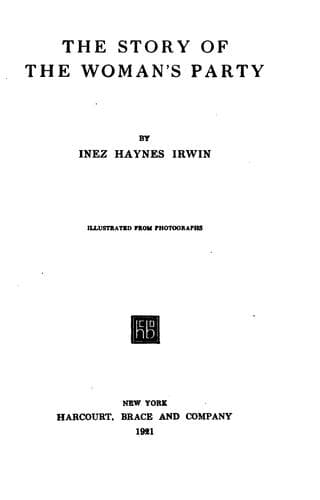
The Story of the Woman's PartyGillmore, Inez Haynes
History
The Story of the Woman's Party
Gillmore, Inez Haynes
National Woman's Party; Paul, Alice, 1885-1977; Women -- Suffrage -- United States
It has been shown with what careful instruction Alice Paul sent these
young adventurers into the wide wide world of unorganized States; but
perhaps justice has not been done to the trust she placed in them and
the consequent extraordinary results. She kept in close telegraphic
communication with them all the time—and yet always, she left them free
to make big decisions and sudden changes in policy. “She made us feel
that we could do it in the first place,” one of them said to me, “and
somehow we did. That sense we had of her—brooding and hovering back
there in Washington—always gave us courage; always gave us the physical
strength to do the things we did and the mental strength to make the
decisions we made.”
As one looks through the lists of these three groups of organizers, one
is astounded at the various kinds of work they did; their versatility.
Mabel Vernon for instance. Her activities form an integral part of the
Woman’s Party history. Mabel Vernon traveling ahead of Sara Bard Field
in her spectacular automobile trip across the country, was more
responsible than anybody, except Mrs. Field herself, for the success of
that trip. Mabel Vernon challenged the President in the course of his
speech at the laying of the corner-stone of the new Headquarters of the
American Federation of Labor in Washington. Mabel Vernon was one of the
women who dropped the banner in the Senate when the President came to
speak before them. Mabel Vernon picketed and went to jail. Mabel Vernon
_seems_ to have organized or spoken in every State in the Union.
Elsie Hill, Doris Stevens—you find them everywhere, luminous spirits
with a new modern adjunct of political-mindedness. Abby Scott Baker was
always on the wing.
One’s mind stops at the names of Vivian Pierce, Lucy Branham, Mary
Gertrude Fendall, Hazel Hunkins. How many and what varying and difficult
things they did! Vivian Pierce in addition to speaking and organizing
and picketing activities, edited the _Suffragist_, and designed the
charming tea-room at Headquarters. As for Lucy Branham—she must have
seemed a stormy petrel to all opposing forces—she had so much the
capacity of being everywhere at once.
When one comes to the last group, a sense—almost of awe—is leavened by a
decided sense of amusement. Julia Emory, Betty Gram, Anita Pollitzer,
Mary Dubrow, Catherine Flanagan are all _little_ girls. But in Suffrage
work, they were active, insistent, and persistent in inverse ratio to
their size. In ratification, that legislature was doomed on which any
two of them descended.
Public-domain text, read in full here on John Shaqi.
Reviews
Reviews
No reviews yet
Be the first to share your thoughts on this work.
Elsewhere in the archive
Join the Discussion
Join the discussion
Sign in to leave a comment or review.
Sign InorCreate an account