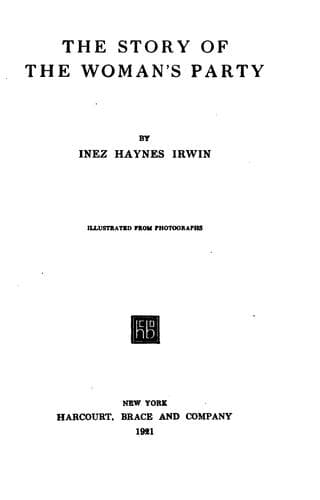
The Story of the Woman's PartyGillmore, Inez Haynes
History
The Story of the Woman's Party
Gillmore, Inez Haynes
National Woman's Party; Paul, Alice, 1885-1977; Women -- Suffrage -- United States
But our minds were not at rest, nor our thoughts quiet. Our victory
was worth nothing unless we could consolidate it quickly. To do this
we had to win the Senate. And the Senate is farther from the people
than the House, and much, much harder to move.
------------------------------------------------------------------------
V
FIGHTING FOR VOTES IN THE SENATE
THE House of Representatives passed the Susan B. Anthony Amendment on
January 10, 1918, by a vote of two hundred and seventy-four to one
hundred and thirty-six. The work of the Woman’s Party was now
concentrated on the Senate. They needed only eleven votes there, and
many Suffragists were optimistic—they thought victory a matter of but a
few weeks. The Woman’s Party knew better. However, in the siege of the
Senate, they continued their policy—to work downwards through the
President, and upward through constituents and political leaders from
the people.
In summing up the situation in the Senate, Alice Paul said:
If the Republicans had the vision to see that it was a wise Party
policy to secure the credit for the passage of the Amendment in the
House, and the Democrats believed it an unwise Party policy to be
responsible for its defeat—the same argument must hold for the vote
in the Senate, for while more than two-thirds of the Republicans had
already promised their votes, only half the Democrats are at present
pledged in the Senate.
The effect of the passing of the Susan B. Anthony Amendment in the House
was, however, not only profound, but immediate. In February, the
Republican National Committee met in St. Louis for the selection of a
Chairman. Abby Scott Baker appeared before the committee, urging a
favorable stand on the Susan B. Anthony amendment. Two women
representing the anti-Suffragists were also to speak. However, when the
anti-Suffragist speakers presented themselves before the Committee, they
found that it had already voted a resolution commending the stand of the
Republican members of the House of Representatives in favor of the
Suffrage Amendment. This was the first favorable expression of the
National Republican Party on the question of Federal Suffrage.
Minnie Bronson said of the anti-Suffragist members:
I looked round for the thirty members who last night were opposed to
Suffrage. I wonder what changed them over night.
Lucy Price, also an anti-Suffragist, asserted:
Your action without even hearing us was worse than a betrayal of us
who are opposed to Suffrage. It was an admission that Party pledges
are meant to be broken.
Public-domain text, read in full here on John Shaqi.
Reviews
Reviews
No reviews yet
Be the first to share your thoughts on this work.
Elsewhere in the archive
Join the Discussion
Join the discussion
Sign in to leave a comment or review.
Sign InorCreate an account