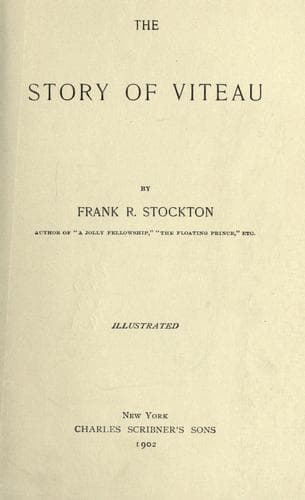
France -- History -- Louis IX, 1226-1270 -- Juvenile fiction
Raymond and Louis were the sons of the Countess of Viteau, whose chateau
stood on a little eminence about half a mile away. Their father, the
Count of Viteau, had been one of the most steadfast adherents and
supporters of the Duke of Burgundy, in his endeavors to maintain the
independence of his dukedom against the claims of the French crown, and
had fallen in one of the battles between the Duke's followers and the
army of the Regent, Queen Blanche, who, in those days, ruled France in
the name of her son, the young King, Louis IX., afterward known as Louis
the Just, or St. Louis.
The Duke's forces had been defeated, Burgundy had been compelled to
acknowledge the supremacy of the French crown, and peace reigned in the
kingdom.
The widowed Countess of Viteau now found herself the sole protector and
guardian of her two boys. Fortunately, she had a large estate, but even
this added to her cares and responsibilities, and rendered her less able
to attend to what she had intended should be the aim and business of her
life—the education of her sons.
Education, in those days, did not mean what it does now. The majority of
the people, even of the upper classes, were not educated at all, some of
the lords and barons being unable to write their names. Printing had not
been invented; all books were in manuscript, and were scarce and
valuable. Most of the learning, such as it was, had been, for a long
time, confined to the monks and priests; but, in the era in which our
two boys lived, people had begun to give more attention to general
education, and there were schools in some of the large cities which were
well attended, and where the students of that day were taught grammar,
logic, rhetoric, music, arithmetic, geometry, and astronomy, although
their studies in most of these branches were not carried very far. The
school of Paris was one of the most celebrated of these institutions.
The Countess of Viteau was among the few ladies of the time who really
cared for an education beyond that which included the small number of
accomplishments then considered necessary to persons of high position.
When quite a young woman, she had learned all that the priests, one or
more of whom generally lived in her father's house, could teach her, and
afterward, when her sons were old enough, she made it her personal
business to attend to their studies. Some things she taught them
herself, and, for other branches, she employed such men of
knowledge—almost always members of some order of the clergy—as could be
obtained.
Public-domain text, read in full here on John Shaqi.
Reviews
Reviews
No reviews yet
Be the first to share your thoughts on this work.
Join the Discussion
Join the discussion
Sign in to leave a comment or review.
Sign InorCreate an account