The Stranger: A Drama, in Five ActsKotzebue, August von
General
The Stranger: A Drama, in Five Acts
Kotzebue, August von
Drama
E-text prepared by Steven desJardins and the Project Gutenberg Online
Distributed Proofreading Team
Note: Project Gutenberg also has an HTML version of this
file which includes the original illustration.
See 20217-h.htm or 20217-h.zip:
(https://www.gutenberg.org/dirs/2/0/2/1/20217/20217-h/20217-h.htm)
or
(https://www.gutenberg.org/dirs/2/0/2/1/20217/20217-h.zip)
Transcriber's note:
Typographical errors from the original 1806 edition
have been preserved.
THE STRANGER;
A Drama, in Five Acts;
As Performed at the Theatre Royal, Drury Lane.
Translated from the German of Kotzebue. by Benjamin Thompson, Esq.
Printed Under the Authority of the Managers from the Prompt Book.
With Remarks by Mrs. Inchbald.
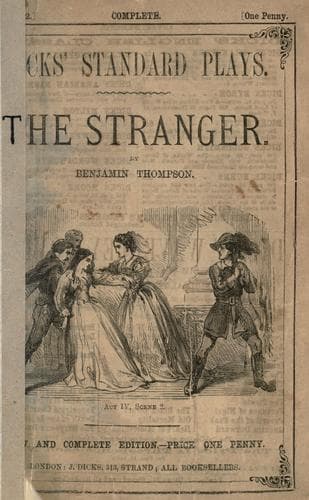
[Illustration: STRANGER
CHILDREN.--DEAR FATHER! DEAR MOTHER! (Act V, Scene II.)
PAINTED BY HOWARD A. PUBLISH'D BY LONGMAN AND CO. ENGRAVED BY NEAGLE
1806]
London:
Printed for Longman, Hurst, Rees, and Orme, Paternoster Row.
Savage and Easingwood, Printers, London.
REMARKS.
There seems to be required by a number of well meaning persons of the
present day a degree of moral perfection in a play, which few literary
works attain; and in which sermons, and other holy productions, are at
times deficient, though written with the purest intention.
To criticise any book, besides the present drama, was certainly not a
premeditated design in writing this little essay; but in support of the
position--that every literary work, however guided by truth, may
occasionally swerve into error, it may here be stated that the meek
spirit of christianity can seldom be traced in any of those pious
writings where our ancient religion, the church of Rome, and its clergy,
are the subjects: and that political writers, in the time of war,
laudably impelled, will slander public enemies into brutes, that the
nation may hate them without offence to brotherly love.
Articles of sacred faith are often so piously, yet so ignorantly
expounded in what are termed systems of education and instruction--that
doubts are created, where all was before secure, and infidelity sown,
where it was meant to be extirpated.
In this general failure of human perfection, the German author of this
play has compassionated--and with a high, a sublime, example before
him--an adultress. But Kotzebue's pity, vitiated by his imperfect
nature, has, it is said, deviated into vice; by restoring this woman to
her former rank in life, under the roof of her injured husband.
To reconcile to the virtuous spectator this indecorum, most calamitous
woes are first depicted as the consequence of illicit love. The deserted
husband and the guilty wife are both presented to the audience as
voluntary exiles from society: the one through poignant sense of sorrow
for the connubial happiness he has lost--the other, from deep contrition
for the guilt she has incurred.
Public-domain text, read in full here on John Shaqi.
Reviews
Reviews
No reviews yet
Be the first to share your thoughts on this work.
Join the Discussion
Join the discussion
Sign in to leave a comment or review.
Sign InorCreate an account