Produced by Henry Flower and the Online Distributed
Proofreading Team at http://www.pgdp.net (This file was
produced from images generously made available by The
Internet Archive/American Libraries.)
Transcriber's Note
Italic text is indicated by ~swung dashes~, bold text by =equals signs=,
subscript by underscores (e.g. CO_{2}), and superscript by caret
signs (e.g. C^1).
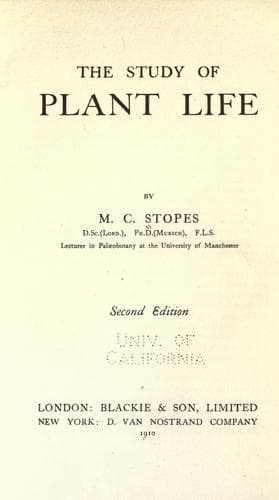
THE STUDY OF PLANT LIFE
~First Impression October 1906.~
~Second Impression February 1907.~
~Second Edition 1910.~
~BY THE SAME AUTHOR~
ANCIENT PLANTS
BEING A SIMPLE ACCOUNT OF THE PAST VEGETATION OF THE EARTH AND OF THE
RECENT IMPORTANT DISCOVERIES MADE IN THIS REALM OF NATURE STUDY
Illustrated. Demy 8vo, 4s. 6d. net
“Miss Stopes’s book is an enterprising and able attempt to popularize
a difficult subject. The really keen student will undoubtedly be
stimulated to pursue the study of fossil plants further, and even those
who are not students will get some new ideas and derive a certain
amount of interest from a book which is sometimes brilliant but never
dull.”--=Nature.=
“Dr. Marie Stopes has made a name for herself in this special line.
Anyone who takes an intelligent interest in the subject cannot fail to
be charmed with the pleasant manner in which Dr. Stopes conveys her
information.”--=Athenæum.=
[Illustration:
PLATE I.
COMMON BRACKEN FERN (~see~ p. 133)]
THE STUDY OF
PLANT LIFE
BY
M. C. STOPES
D.SC.(LOND.), PH.D.(MUNICH), F.L.S.
Lecturer in Palæobotany at the University of Manchester
~Second Edition~
LONDON: BLACKIE & SON, LIMITED
NEW YORK: D. VAN NOSTRAND COMPANY
1910
PRINTED AT
THE VILLAFIELD PRESS
GLASGOW
PREFACE
As a result of the present efforts to raise the standard of education
in this country, many different “Methods of Teaching” are receiving our
grave consideration. So insistent are their advocates, that we stand
in some danger of forgetting that ~learning~, rather than teaching,
is the essential factor in education. It is not the knowledge given
us ready-made by the teacher, but that which we ~learn~, acquiring it
by our own efforts, which enters into our being and becomes a lasting
possession.
Therefore this little book does not pretend so much to teach as to act
as a guide along the road for those who desire to learn something about
the plants around them; hence it points out how much they can easily
see for themselves of the wonderful life and work of the silent plants.
It is planned for children, whose quick sympathies are more readily
drawn towards the ~life~ of things than to the dry facts of morphology
or classification. Its “Leitmotif” is therefore the story of life,
and those of its activities which find expression in the plant world.
Perhaps it may serve to awaken interest in some older people who have
not yet been initiated into these mysteries.
Public-domain text, read in full here on John Shaqi.
Reviews
Reviews
No reviews yet
Be the first to share your thoughts on this work.
Join the Discussion
Join the discussion
Sign in to leave a comment or review.
Sign InorCreate an account