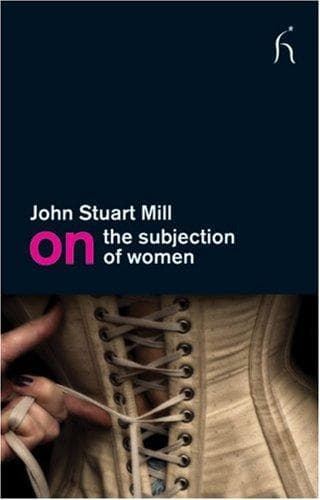
Women -- Social and moral questions; Women's rights
Produced by Michael Roe and the Online Distributed
Proofreading Team at https://www.pgdp.net (This file was
produced from images generously made available by The
Internet Archive/American Libraries.)
THE
SUBJECTION
OF
WOMEN
BY
JOHN STUART MILL
LONDON
LONGMANS, GREEN, READER, AND DYER
1869
LONDON:
SAVILL, EDWARDS AND CO., PRINTERS, CHANDOS STREET,
COVENT GARDEN.
CHAPTER I.
The object of this Essay is to explain as clearly as I am able, the
grounds of an opinion which I have held from the very earliest period
when I had formed any opinions at all on social or political matters,
and which, instead of being weakened or modified, has been constantly
growing stronger by the progress of reflection and the experience of
life: That the principle which regulates the existing social
relations between the two sexes--the legal subordination of one sex
to the other--is wrong in itself, and now one of the chief hindrances
to human improvement; and that it ought to be replaced by a principle
of perfect equality, admitting no power or privilege on the one side,
nor disability on the other.
The very words necessary to express the task I have undertaken, show
how arduous it is. But it would be a mistake to suppose that the
difficulty of the case must lie in the insufficiency or obscurity of
the grounds of reason on which my conviction rests. The difficulty is
that which exists in all cases in which there is a mass of feeling to
be contended against. So long as an opinion is strongly rooted in the
feelings, it gains rather than loses in stability by having a
preponderating weight of argument against it. For if it were accepted
as a result of argument, the refutation of the argument might shake
the solidity of the conviction; but when it rests solely on feeling,
the worse it fares in argumentative contest, the more persuaded its
adherents are that their feeling must have some deeper ground, which
the arguments do not reach; and while the feeling remains, it is
always throwing up fresh intrenchments of argument to repair any
breach made in the old. And there are so many causes tending to make
the feelings connected with this subject the most intense and most
deeply-rooted of all those which gather round and protect old
institutions and customs, that we need not wonder to find them as yet
less undermined and loosened than any of the rest by the progress of
the great modern spiritual and social transition; nor suppose that
the barbarisms to which men cling longest must be less barbarisms
than those which they earlier shake off.
Public-domain text, read in full here on John Shaqi.
Reviews
Reviews
No reviews yet
Be the first to share your thoughts on this work.
Join the Discussion
Join the discussion
Sign in to leave a comment or review.
Sign InorCreate an account