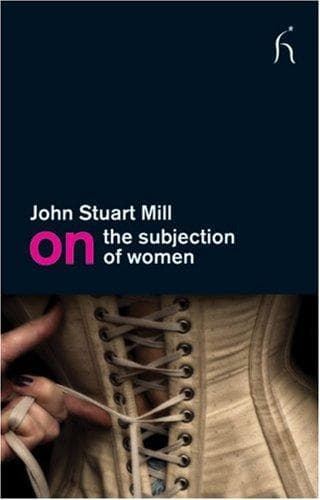
Women -- Social and moral questions; Women's rights
But, it will be said, the rule of men over women differs from all
these others in not being a rule of force: it is accepted
voluntarily; women make no complaint, and are consenting parties to
it. In the first place, a great number of women do not accept it.
Ever since there have been women able to make their sentiments known
by their writings (the only mode of publicity which society permits
to them), an increasing number of them have recorded protests against
their present social condition: and recently many thousands of them,
headed by the most eminent women known to the public, have petitioned
Parliament for their admission to the Parliamentary Suffrage. The
claim of women to be educated as solidly, and in the same branches of
knowledge, as men, is urged with growing intensity, and with a great
prospect of success; while the demand for their admission into
professions and occupations hitherto closed against them, becomes
every year more urgent. Though there are not in this country, as
there are in the United States, periodical Conventions and an
organized party to agitate for the Rights of Women, there is a
numerous and active Society organized and managed by women, for the
more limited object of obtaining the political franchise. Nor is it
only in our own country and in America that women are beginning to
protest, more or less collectively, against the disabilities under
which they labour. France, and Italy, and Switzerland, and Russia now
afford examples of the same thing. How many more women there are who
silently cherish similar aspirations, no one can possibly know; but
there are abundant tokens how many _would_ cherish them, were they
not so strenuously taught to repress them as contrary to the
proprieties of their sex. It must be remembered, also, that no
enslaved class ever asked for complete liberty at once. When Simon de
Montfort called the deputies of the commons to sit for the first time
in Parliament, did any of them dream of demanding that an assembly,
elected by their constituents, should make and destroy ministries,
and dictate to the king in affairs of state? No such thought entered
into the imagination of the most ambitious of them. The nobility had
already these pretensions; the commons pretended to nothing but to be
exempt from arbitrary taxation, and from the gross individual
oppression of the king's officers. It is a political law of nature
that those who are under any power of ancient origin, never begin by
complaining of the power itself, but only of its oppressive exercise.
There is never any want of women who complain of ill usage by their
husbands. There would be infinitely more, if complaint were not the
greatest of all provocatives to a repetition and increase of the ill
usage. It is this which frustrates all attempts to maintain the power
but protect the woman against its abuses. In no other case (except
that of a child) is the person who has been proved judicially to have
Public-domain text, read in full here on John Shaqi.
Reviews
Reviews
No reviews yet
Be the first to share your thoughts on this work.
Join the Discussion
Join the discussion
Sign in to leave a comment or review.
Sign InorCreate an account