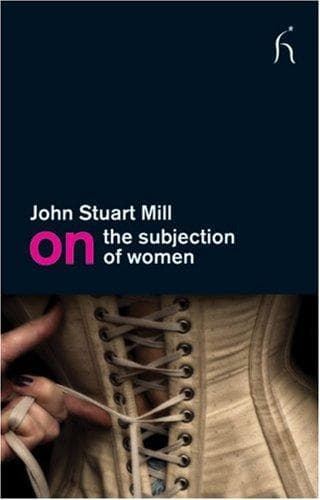
Women -- Social and moral questions; Women's rights
At present, in the more improved countries, the disabilities of women
are the only case, save one, in which laws and institutions take
persons at their birth, and ordain that they shall never in all their
lives be allowed to compete for certain things. The one exception is
that of royalty. Persons still are born to the throne; no one, not of
the reigning family, can ever occupy it, and no one even of that
family can, by any means but the course of hereditary succession,
attain it. All other dignities and social advantages are open to the
whole male sex: many indeed are only attainable by wealth, but wealth
may be striven for by any one, and is actually obtained by many men
of the very humblest origin. The difficulties, to the majority, are
indeed insuperable without the aid of fortunate accidents; but no
male human being is under any legal ban: neither law nor opinion
superadd artificial obstacles to the natural ones. Royalty, as I have
said, is excepted: but in this case every one feels it to be an
exception--an anomaly in the modern world, in marked opposition to
its customs and principles, and to be justified only by extraordinary
special expediencies, which, though individuals and nations differ in
estimating their weight, unquestionably do in fact exist. But in this
exceptional case, in which a high social function is, for important
reasons, bestowed on birth instead of being put up to competition,
all free nations contrive to adhere in substance to the principle
from which they nominally derogate; for they circumscribe this high
function by conditions avowedly intended to prevent the person to
whom it ostensibly belongs from really performing it; while the
person by whom it is performed, the responsible minister, does obtain
the post by a competition from which no full-grown citizen of the
male sex is legally excluded. The disabilities, therefore, to which
women are subject from the mere fact of their birth, are the solitary
examples of the kind in modern legislation. In no instance except
this, which comprehends half the human race, are the higher social
functions closed against any one by a fatality of birth which no
exertions, and no change of circumstances, can overcome; for even
religious disabilities (besides that in England and in Europe they
have practically almost ceased to exist) do not close any career to
the disqualified person in case of conversion.
Public-domain text, read in full here on John Shaqi.
Reviews
Reviews
No reviews yet
Be the first to share your thoughts on this work.
Join the Discussion
Join the discussion
Sign in to leave a comment or review.
Sign InorCreate an account