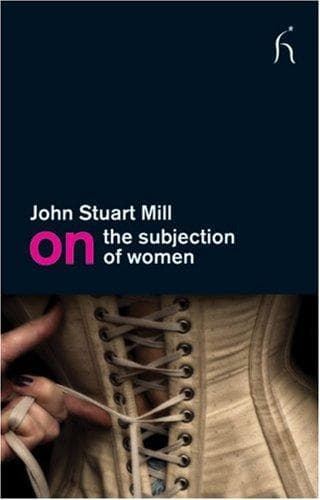
Women -- Social and moral questions; Women's rights
[Footnote 1: Especially is this true if we take into consideration
Asia as well as Europe. If a Hindoo principality is strongly,
vigilantly, and economically governed; if order is preserved without
oppression; if cultivation is extending, and the people prosperous,
in three cases out of four that principality is under a woman's rule.
This fact, to me an entirely unexpected one, I have collected from a
long official knowledge of Hindoo governments. There are many such
instances: for though, by Hindoo institutions, a woman cannot reign,
she is the legal regent of a kingdom during the minority of the heir;
and minorities are frequent, the lives of the male rulers being so
often prematurely terminated through the effect of inactivity and
sensual excesses. When we consider that these princesses have never
been seen in public, have never conversed with any man not of their
own family except from behind a curtain, that they do not read, and
if they did, there is no book in their languages which can give them
the smallest instruction on political affairs; the example they
afford of the natural capacity of women for government is very
striking.]
[Footnote 2: “It appears to be the same right turn of mind which
enables a man to acquire the _truth_, or the just idea of what is
right, in the ornaments, as in the more stable principles of art. It
has still the same centre of perfection, though it is the centre of a
smaller circle.--To illustrate this by the fashion of dress, in which
there is allowed to be a good or bad taste. The component parts of
dress are continually changing from great to little, from short to
long; but the general form still remains: it is still the same
general dress which is comparatively fixed, though on a very slender
foundation; but it is on this which fashion must rest. He who invents
with the most success, or dresses in the best taste, would probably,
from the same sagacity employed to greater purposes, have discovered
equal skill, or have formed the same correct taste, in the highest
labours of art.”--_Sir Joshua Reynolds' Discourses_, Disc. vii.]
CHAPTER IV.
There remains a question, not of less importance than those already
discussed, and which will be asked the most importunately by those
opponents whose conviction is somewhat shaken on the main point. What
good are we to expect from the changes proposed in our customs and
institutions? Would mankind be at all better off if women were free?
If not, why disturb their minds, and attempt to make a social
revolution in the name of an abstract right?
Public-domain text, read in full here on John Shaqi.
Reviews
Reviews
No reviews yet
Be the first to share your thoughts on this work.
Elsewhere in the archive
Join the Discussion
Join the discussion
Sign in to leave a comment or review.
Sign InorCreate an account