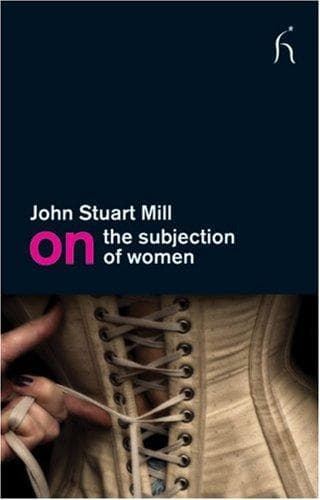
Women -- Social and moral questions; Women's rights
It is hardly to be expected that this question will be asked in
respect to the change proposed in the condition of women in marriage.
The sufferings, immoralities, evils of all sorts, produced in
innumerable cases by the subjection of individual women to individual
men, are far too terrible to be overlooked. Unthinking or uncandid
persons, counting those cases alone which are extreme, or which
attain publicity, may say that the evils are exceptional; but no one
can be blind to their existence, nor, in many cases, to their
intensity. And it is perfectly obvious that the abuse of the power
cannot be very much checked while the power remains. It is a power
given, or offered, not to good men, or to decently respectable men,
but to all men; the most brutal, and the most criminal. There is no
check but that of opinion, and such men are in general within the
reach of no opinion but that of men like themselves. If such men did
not brutally tyrannize over the one human being whom the law compels
to bear everything from them, society must already have reached a
paradisiacal state. There could be no need any longer of laws to curb
men's vicious propensities. Astræa must not only have returned to
earth, but the heart of the worst man must have become her temple.
The law of servitude in marriage is a monstrous contradiction to all
the principles of the modern world, and to all the experience through
which those principles have been slowly and painfully worked out. It
is the sole case, now that negro slavery has been abolished, in which
a human being in the plenitude of every faculty is delivered up to
the tender mercies of another human being, in the hope forsooth that
this other will use the power solely for the good of the person
subjected to it. Marriage is the only actual bondage known to our
law. There remain no legal slaves, except the mistress of every
house.
It is not, therefore, on this part of the subject, that the question
is likely to be asked, _Cui bono_? We may be told that the evil would
outweigh the good, but the reality of the good admits of no dispute.
In regard, however, to the larger question, the removal of women's
disabilities--their recognition as the equals of men in all that
belongs to citizenship--the opening to them of all honourable
employments, and of the training and education which qualifies for
those employments--there are many persons for whom it is not enough
that the inequality has no just or legitimate defence; they require
to be told what express advantage would be obtained by abolishing it.
Public-domain text, read in full here on John Shaqi.
Reviews
Reviews
No reviews yet
Be the first to share your thoughts on this work.
Elsewhere in the archive
Join the Discussion
Join the discussion
Sign in to leave a comment or review.
Sign InorCreate an account