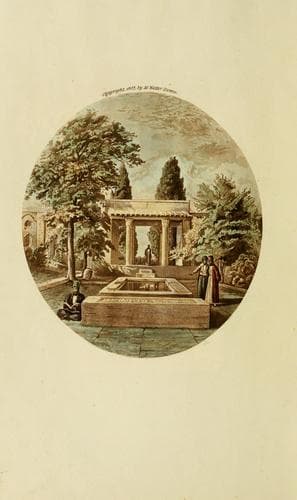
The Sufistic Quatrains of Omar KhayyamOmar Khayyam
ReligionSufism
The Sufistic Quatrains of Omar Khayyam
Omar Khayyam
FitzGerald, Edward, 1809-1883; Sufi poetry
The death of Malek-Chah took place unexpectedly soon after that of
Nizam-el-Moulk, and Hassan, hastening to profit by some experiments of
the celebrated Sultan Sandjar, Malek-Chah's successor, there were
incessant wars in the different branches of the House of Seldjoukides,
wars which prolonged themselves until the death of Tougroul III., or
from forty to forty-five years. Sultan Sandjar, rightly disturbed at the
progress of Hassan's invasion, resolved to entirely destroy a band of
brigands in his territory, whose depredations and murders had spread
terror in all the provinces. To this end, he re-organized an army with
which he marched in person against the aggressors; but, arrived at a
certain distance from Mount Alamout, he saw one morning, upon waking, a
dagger sunk in the earth near the bolster of his bed, whose blade
pierced a note addressed to him, where he read, with fright, these
words:
«O Sandjar! know that if I had not wished to respect your days, the
hand which sunk this dagger in the earth could as well have sunk it
in your heart.»
It is said that the Sultan was so overcome by the reading of this note,
which revealed to him the marvellous power of Hassan-Sebbah over his
trusty followers, that he relinquished for the time being his plan of
attack.
But let us return to Khayyam, who, remaining a stranger to all these
alternatives of wars, intrigues, and revolts with which this epoch was
so filled, lived tranquilly in his native village, giving himself up to
a passionate study of the philosophy of the Sufis. Surrounded by
numerous friends he sought with them, in study and entertainment, that
ecstatic contemplation which others believe that they find in uttering
cries and screams until the voice is gone, as the crying dervishes do;
or in the circular movements that are practiced with frenzy until
vertigo ensues, as by the whirling dervishes; or finally, in the
atrocious tortures which the Hindoos inflict upon themselves, until they
lose consciousness. The Persian historians state that Khayyam loved
especially to converse and drink with his friends, in the moonlight on a
terrace before his house, seated upon a carpet, surrounded by singers
and musicians, with a cup-bearer, who, cup in hand, presented it in turn
to the joyous guests. We believe we cannot better terminate this rapid
biographical and historic sketch than in adding to the life and works of
our poet two very characteristic quotations.
During one of these evenings of which we are speaking, there suddenly
came a gust of wind which extinguished the candles and overturned the
pitcher of wine that was imprudently placed too near the edge of the
terrace. The pitcher was broken and the wine spilled. Immediately
Khayyam, irritated, improvised this impious quatrain, addressed to the
All-Powerful:
Public-domain text, read in full here on John Shaqi.
Reviews
Reviews
No reviews yet
Be the first to share your thoughts on this work.
Elsewhere in the archive
Join the Discussion
Join the discussion
Sign in to leave a comment or review.
Sign InorCreate an account