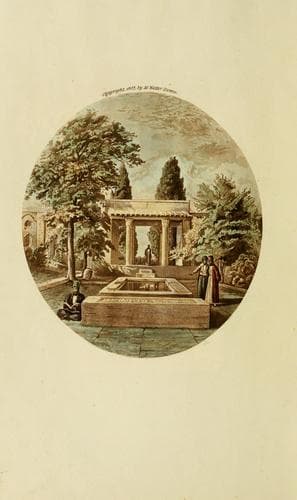
The Sufistic Quatrains of Omar KhayyamOmar Khayyam
ReligionSufism
The Sufistic Quatrains of Omar Khayyam
Omar Khayyam
FitzGerald, Edward, 1809-1883; Sufi poetry
TAMAM SHUD.
NOTES.
(Stanza II.) The «_False Dawn_»; _Subhi kazib_, a transient Light on the
Horizon about an hour before the _Subhi sadik_, or True Dawn; a
well-known Phenomenon in the East.
(IV.) New Year. Beginning with the Vernal Equinox, it must be
remembered; and (howsoever the old Solar Year is practically superseded
by the clumsy _Lunar_ Year that dates from the Mohammedan Hegira) still
commemorated by a Festival that is said to have been appointed by the
very Jamshyd whom Omar so often talks of, and whose yearly Calendar he
helped to rectify.
«The sudden approach and rapid advance of the Spring,» says Mr.
Binning,[13] «are very striking. Before the Snow is well off the Ground,
the Trees burst into Blossom, and the Flowers start forth from the Soil.
At _Now Rooz_ [_their_ New Year's Day] the Snow was lying in patches on
the Hills and in the shaded Valleys, while the Fruit-trees in the
Gardens were budding beautifully, and green Plants and Flowers springing
up on the Plains on every side--
‹And on old Hyems' Chin and icy Crown
An odorous Chaplet of sweet Summer buds
Is, as in mockery, set›--
Among the Plants newly appeared I recognised some old Acquaintances I
had not seen for many a Year: among these, two varieties of the
Thistle--a coarse species of Daisy like the ‹Horse-gowan›--red and white
Clover--the Dock--the blue Corn-flower--and that vulgar Herb the
Dandelion rearing its yellow crest on the Banks of the Water-courses.»
The Nightingale was not yet heard, for the Rose was not yet blown; but
an almost identical Blackbird and Wood-pecker helped to make up
something of a North-country Spring.
«The White Hand of Moses.» Exodus iv. 6; where Moses draws forth his
Hand--not, according to the Persians, «_leprous as Snow,_» --but
_white_, as our May-blossom in Spring perhaps. According to them also
the Healing Power of Jesus resided in His Breath.
(V.) Iram, planted by King Shaddad, and now sunk somewhere in the Sands
of Arabia. Jamshyd's Seven-ring'd Cup was typical of the 7 Heavens, 7
Planets, 7 Seas, etc., and was a _Divining Cup_.
(VI.) _Pehlevi_, the old Heroic _Sanskrit_ of Persia. Hafiz also speaks
of the Nightingale's _Pehlevi_, which did not change with the People's.
I am not sure if the fourth line refers to the Red Rose looking sickly,
or to the Yellow Rose that ought to be Red; Red, White, and Yellow Roses
all common in Persia. I think that Southey in his «Common-Place Book,»
quotes from some Spanish author about the Rose being White till 10
o'clock; «_Rosa Perfecta_» at 2; and «_perfecta incarnada_» at 5.
(X.) Rustum, the «Hercules» of Persia, and Zal his Father, whose
exploits are among the most celebrated in the Shahnama. Hatim Tai, a
well-known type of Oriental generosity.
(XIII.) A Drum--beaten outside a Palace.
(XIV.) That is, the Rose's Golden Centre.
Public-domain text, read in full here on John Shaqi.
Reviews
Reviews
No reviews yet
Be the first to share your thoughts on this work.
Join the Discussion
Join the discussion
Sign in to leave a comment or review.
Sign InorCreate an account