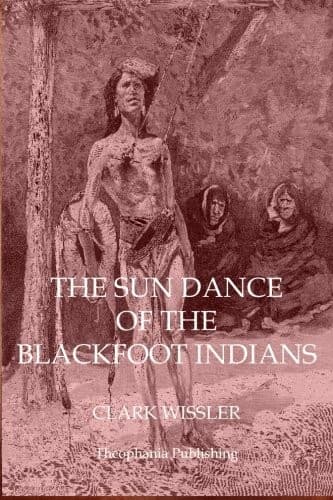
The Sun Dance of the Blackfoot Indians — John Shaqi
The Sun Dance of the Blackfoot IndiansWissler, Clark
Religion
The Sun Dance of the Blackfoot Indians
Wissler, Clark
Siksika Indians; Sun dance
Since the plan of this section is to give an ethnological presentation
of the Blackfoot sun dance, rather than a logically unfolding
description of the ceremony as seen at a specified time, we shall
present the general program now and take up later a somewhat analytical
detailed discussion of the various phases of the ceremony. By this
method, we shall be able to concentrate our attention upon a single
ceremonial concept without the distraction arising from contemporaneous
and intrusive procedures based upon other concepts, for as we shall see,
this sun dance is a true composite. The following schedule is not given
as the one observed by the writer, but as the one regarded as proper and
believed to have been followed before the various divisions of the
Blackfoot were under the complete domination of the Canadian and United
States governments.
PREPARATION PERIOD.
After making a vow to purchase a sun dance bundle, the woman and her
husband make the necessary arrangements and perform the prescribed
rites. This is an indefinite period. At the approach of summer, the
invitation tobacco is sent to all the bands and the camp circle is
formed.
PROGRAM BY DAYS.
_First Day._ The program opens with moving camp to a site previously
selected. On the morning of this day, the medicine woman begins to fast,
which may be taken as the real beginning of the ceremony. If the
ceremony of "cutting the tongues" has not been previously performed or
completed, it is now in order. In any event, the father and any male
assistants he may choose to invite, spend a part of the day in "praying
and singing over the tongues." A society brings in willows and a
hundred-willow sweathouse is built.
_Second Day._ In the morning, the camp moves again to a site still
nearer that proposed for the sun dance. A few green boughs of cottonwood
are kept around the base of the medicine woman's tipi as a sign of its
sanctity. A sweathouse is made, as on the previous day. "Praying and
singing over the tongues" continues during the day and evening.
_Third Day._ The same as the second day.
_Fourth Day._ The camp moves again; this time to the site of the sun
dance. In the afternoon, the fourth and last hundred-willow sweathouse
is built and used. The singing continues during the evening in the
medicine woman's tipi.
Public-domain text, read in full here on John Shaqi.
Reviews
Reviews
No reviews yet
Be the first to share your thoughts on this work.
Join the Discussion
Join the discussion
Sign in to leave a comment or review.
Sign InorCreate an account