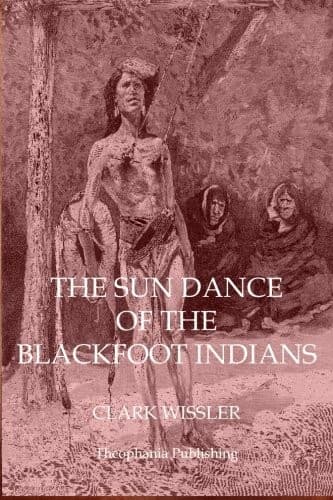
The Sun Dance of the Blackfoot IndiansWissler, Clark
Religion
The Sun Dance of the Blackfoot Indians
Wissler, Clark
Siksika Indians; Sun dance
The young man went up to the sacred pole, and while his countenance
was exceedingly pale, and his frame trembling with emotion, threw
his arms around it, and prayed earnestly for strength to pass
successfully through the trying ordeal. His prayer ended he moved
backward until the flesh was fully extended, and placing a small
bone whistle in his mouth, he blew continuously upon it a series of
short sharp sounds, while he threw himself backward, and danced
until the flesh gave way and he fell. Previous to his tearing
himself free from the lariats, he seized the drum with both hands
and with a sudden pull tore the flesh on his back, dashing the drum
to the ground amid the applause of the people. As he lay on the
ground, the operators examined his wounds, cut off the flesh that
was hanging loosely, and the ceremony was at an end. In former years
the head of a buffalo was fastened by a rope on the back of the
person undergoing the feat of self-immolation, but now a drum is
used for that purpose.
From two to five persons undergo this torture every Sun-Dance. Its
object is military and religious. It admits the young man into the
noble band of warriors, whereby he gains the esteem of his fellows,
and opens up the path to fortune and fame. But it is chiefly a
religious rite. In a time of sickness, or danger, or in starting
upon some dangerous expedition, the young man prays to Natos for
help, and promises to give himself to Natos if his prayers are
answered. Upon his return, when the Annual Sun-Dance is held, he
fulfills his vow, gives himself to his god, and thus performs a
twofold duty. Of course the applause of the people and the
exhibition of courage are important factors in this rite, but its
chief feature is a religious one. Instead of being a time of
feasting and pleasure, the Sun-Dance is a military and religious
festival, in connection with which there are occasions for joy, and
the feast enhances the pleasure.[16]
It may be well to note that the offering of bits of flesh to the sun was
a general practice not necessarily associated with the sun dance. Many
comparatively young men now living (1904) bear numerous scars testifying
to such offerings. When in perilous situations a finger would sometimes
be struck off with a call upon the sun for help. Among the Blood, such
sacrifice of a finger by women as well as men was common at the sun
dance.[17] These facts concerning the more general practice of
mutilating the body to win the approval of the sun suggest that if the
cutting ceremony is intrusive, it either found on hand a series of
analogous customs or brought with it a concept that afterwards gave
birth to them. It may be observed that the form of costume and dance is
strikingly like that employed by the present weather dancers.
Public-domain text, read in full here on John Shaqi.
Reviews
Reviews
No reviews yet
Be the first to share your thoughts on this work.
Join the Discussion
Join the discussion
Sign in to leave a comment or review.
Sign InorCreate an account