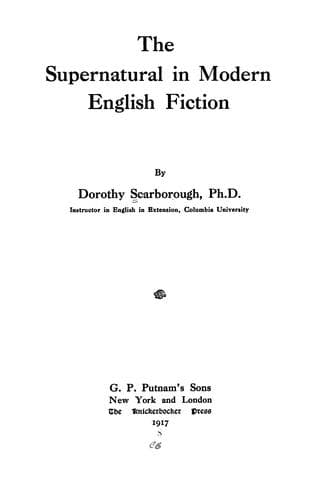
The Supernatural in Modern English FictionScarborough, Dorothy
History
The Supernatural in Modern English Fiction
Scarborough, Dorothy
English fiction -- History and criticism; Supernatural in literature
We still have the hoodoo man of colored persuasion, and the redskin
medicine-man, together with Oriental sorcerers from Kipling and
others. Examples are: _In the House of Suddoo_, by Kipling, where the
wonder-worker unites a canny knowledge of the telephone and telegraph
along with his unholy art; _Red Debts_, by Lumley Deakin, where the
Indian magician exacts a terrible penalty for the wrong done him, and
where his diabolic appearance to claim his victim leaves one in doubt
as to whether he has not sent his chief in his place; _The Monkey's
Paw_, by W. W. Jacobs, a curdling story of a magic curse given by an
Oriental sorcerer, by which the paw of a dead monkey grants three
wishes that have a dreadful boomerang power; _Black Magic_, by Jessie
Adelaide Weston,--who claims that all her supernatural stories are
strictly true--the narrative of an old Indian sorcerer that changes
himself into a hair mat and is shot for his pains. He has obtained
power over the house by being given a hair from the mat by the
uninitiated mistress. Hair, you must know, has great power of evil in
the hands of witches and sorcerers, as in the case of the evil ones in
_The Talisman_, who received their thrall over the maidens by one hair
from each head. F. Marion Crawford's _Khaled_ is a story of magic art.
Khaled is one of the genii converted by reading the Koran, who wishes
to be a mortal man with a soul. He is given the right to do so if he
can win the love of a certain woman. Hence he is born into the world,
like Adam, a full-grown man, to be magically clothed and equipped, by
the transformation of leaves and twigs into garments and armor, and the
changing of a locust into an Arabian steed. After many supernatural
adventures, he receives his soul from an angel. The soul, at first a
crescent flame,
immediately took shape and became the brighter image of Khaled
himself. And when he had looked at it fixedly for a few
minutes--the vision of himself had disappeared and before he was
aware it had entered his own body and taken up its life with him.
This is a parallel to the cases of ghostly doubles discussed in the
previous chapter.
Public-domain text, read in full here on John Shaqi.
Reviews
Reviews
No reviews yet
Be the first to share your thoughts on this work.
Elsewhere in the archive
Join the Discussion
Join the discussion
Sign in to leave a comment or review.
Sign InorCreate an account