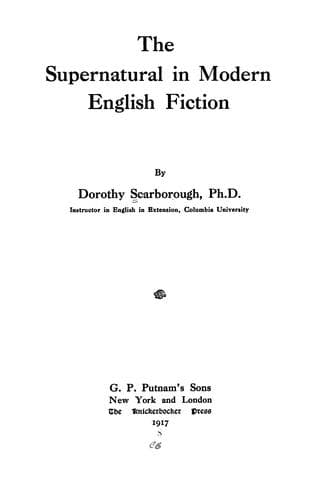
The Supernatural in Modern English FictionScarborough, Dorothy
History
The Supernatural in Modern English Fiction
Scarborough, Dorothy
English fiction -- History and criticism; Supernatural in literature
The magician shows a disposition to adapt himself to contemporary
conditions and to change his personality with the times. Not so the
witch. She is a permanent figure. She has appeared in the various
forms of literature, in Elizabethan drama, in Gothic romance, in
modern poetry, the novel and the short story, and is very much alive
to-day. We have witches young and old. We have the fake witch, like the
hoax ghost; the imputed witch and the genuine article. We have witch
stories melodramatic, romantic, tragic, comic, and satiric, showing
the influence of the great creations of past literature with modern
adaptations and additions. English poetry is full of witchery, perhaps
largely the result of the Celtic influence on our literature. The
poetic type of witchcraft is brought out in such poems as Coleridge's
_Christabel_, where the beauty and suggestiveness veil the sense of
unearthly evil; or in Shelley's _Witch of Atlas_, where the woman
appears as a symbol of alluring loveliness possessing none of the
hideous aspects seen in other weird women. The water enchantress in
Shelley's fragment of an unfinished drama might be mentioned as another
example while Keats's _La Belle Dame sans Merci_ has a magical charm
all her own. Christina Rossetti's _Goblin Market_ shows a peculiar
aspect of magic, as also Mrs. Browning's _The Lay of the Brown Rosary_.
On the contrary, Milton's _Comus_, Robert Herrick's _The Hag_, and
James Hogg's _The Witch of Fife_ illustrate the uglier aspects of
enchantment.
There are two definite types of witches seen in English fiction, the
first being merely the reputed witch, the woman who is falsely accused
or suspected of black arts, and who either is persecuted, or else gains
what she wishes by hints of her traffic in evil, like the Old Granny
Young in _Mine Host and the Witch_, by James Blythe, who chants as a
charm-rune,
"A curse shall lay on water and land
For the thing denied the witch's hand,"
Public-domain text, read in full here on John Shaqi.
Reviews
Reviews
No reviews yet
Be the first to share your thoughts on this work.
Elsewhere in the archive
Join the Discussion
Join the discussion
Sign in to leave a comment or review.
Sign InorCreate an account