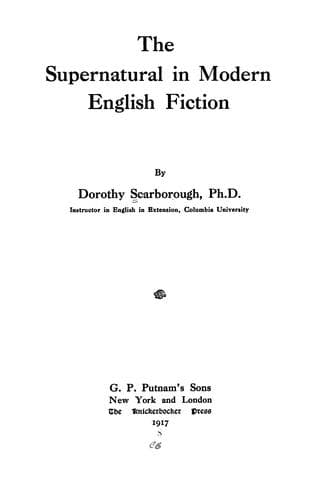
The Supernatural in Modern English FictionScarborough, Dorothy
History
The Supernatural in Modern English Fiction
Scarborough, Dorothy
English fiction -- History and criticism; Supernatural in literature
so that everybody is afraid to refuse her whatever she demands. This
is a highly conventionalized type of the motif and, though it is found
in great numbers in modern fiction, is not particularly important. The
principal complications of the plot are usually the same, the character
known as the witch being either an appealing figure winning sympathy
because of her beauty and youth, or else touching to pity because of
her age and infirmities. No person of average age or pulchritude is
ever accused of witchcraft in English fiction. She is always very
old and poor or young and lovely. Item also, she invariably has two
lovers, in the latter case. She is merely a romantic peg on which to
hang a story, not always real as a human being and not a real witch.
In these stories the only magic used is love, the fair maid having
unintentionally charmed the heart of a villain, who, failing to win
her, accuses her of witchcraft in order to frighten her into love.
In some of the novels and stories the victim is actually executed,
while in others she is rescued by her noble lover at the fifty-ninth
second. We have the pursuing villain, the distressed innocence, the
chivalric lover disporting themselves in late Gothic fashion over
many romances. Even Mary Johnston with her knowledge of Colonial
times and her power to give atmosphere to the past does not succeed
in imparting the breath of life to her late novel of witchcraft,
_The Witch_. These pink-and-white beauties who speak in Euphuistic
sentences, who show a lamblike defiance toward the dark tempters,
who breathe prayers to heaven for protection and forgiveness to
their enemies in one breath, who die or are rescued with equal grace
and propriety,--one is carried away from the scaffold by Kidd, the
pirate, thus delaying for several chapters her rescue by her faithful
lover--do not really touch the heart any more than they interest the
intellect. Yet there are occasional instances of the imputed witch
who seems real despite her handicap of beauty and youth, as Iseult le
Desireuse, in Maurice Hewlett's _Forest Lovers_, whom Prosper le Gai
weds to save from the hangman. The young woman in F. Marion Crawford's
_Witch of Prague_ might be called a problematic witch, for while she
does undoubtedly work magic, it is for the most part attributed to her
powers of hypnotism rather than to the black art itself. We find an
excellent example of the reputed witch who is a woman of real charm
and individuality, in D'Annunzio's _The Daughter of Jorio_, where the
young girl is beset by cruel dangers because of her charm and her
lonely condition, and who rises to tragic heights of sacrifice to save
her lover from death, choosing to be burned to death as a witch to save
him from paying the penalty of murder. She actually convinces him, as
well as the others, that she has bewitched him by unholy powers, that
she has slain his father and made him believe that he himself did it
Public-domain text, read in full here on John Shaqi.
Reviews
Reviews
No reviews yet
Be the first to share your thoughts on this work.
Elsewhere in the archive
Join the Discussion
Join the discussion
Sign in to leave a comment or review.
Sign InorCreate an account