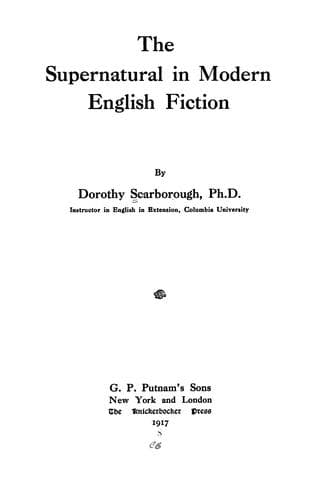
The Supernatural in Modern English FictionScarborough, Dorothy
History
The Supernatural in Modern English Fiction
Scarborough, Dorothy
English fiction -- History and criticism; Supernatural in literature
Algernon Blackwood advances the theory that the werewolf is a true
psychical fact of profound importance, however it may have been garbled
by superstition. He thinks that the werewolf is the projection of the
untamed slumbering sanguinary instincts of man, "scouring the world
in his fluidic body, the body of desire." As the mind wanders free
from the conscious control of the will in sleep, so the body may free
itself from the fetters of mind or of custom and go forth in elemental
form to satisfy its craving to slay, to slake its wild thirst for
blood. O'Donnell says that werewolves may be phantasms of the dead that
cannot be at peace, or a certain kind of Elementals. He also thinks
that they may be the projection of one phase of man's nature, of the
cruelty latent in mankind that seeks expression in this way. According
to that theory, a chap might have a whole menagerie inside him, to
turn loose at intervals, which would be exciting but rather risky
for society. It was doubtless a nature such as this that Maupassant
attempts to describe in his story _The Wolf_, where the man has all the
instincts of the wolf yet never changes his human form.
The werewolf in fiction has suffered the same leveling influence
that we have observed in the case of the ghost, the devil, the
witch, and the vampire. He is becoming a more psychical creature, a
romantic figure to be sympathized with, rather than a beast to be
utterly condemned. In recent fiction the werewolf is represented
as an involuntary and even unconscious departure from the human,
who is shocked when he learns the truth about himself. Whether he
be the victim of a divine curse, an agent of atavistic tendencies,
or a being who thus gives vent to his real and brutish instincts,
we feel a sympathy with him. We analyze his motives--at a safe
distance--seek to understand his vagaries and to estimate his kinship
with us. We think of him now as a noble figure in fiction, a lupine
Galahad like Blackwood's, a renunciatory hero like Eugene Field's
or what not. Or we reflect that he may be a case of metempsychosis
and treat him courteously, for who knows what we may be ourselves
some day? The werewolf has not figured in poetry or in the drama as
have other supernatural beings, as the ghost, the devil, the witch,
the vampire,--one wonders why. He is a dramatic figure and his
character-analysis might well furnish themes for poetry though stage
presentation would have its difficulties.
* * * * *
Public-domain text, read in full here on John Shaqi.
Reviews
Reviews
No reviews yet
Be the first to share your thoughts on this work.
Elsewhere in the archive
Join the Discussion
Join the discussion
Sign in to leave a comment or review.
Sign InorCreate an account